
Future Of AI Communication:
How Technology Is Changing Customer Expectations
Customers expect more. Technology makes it possible. Here is what every business needs to understand about the AI communication shift happening right now.
Quick Answer
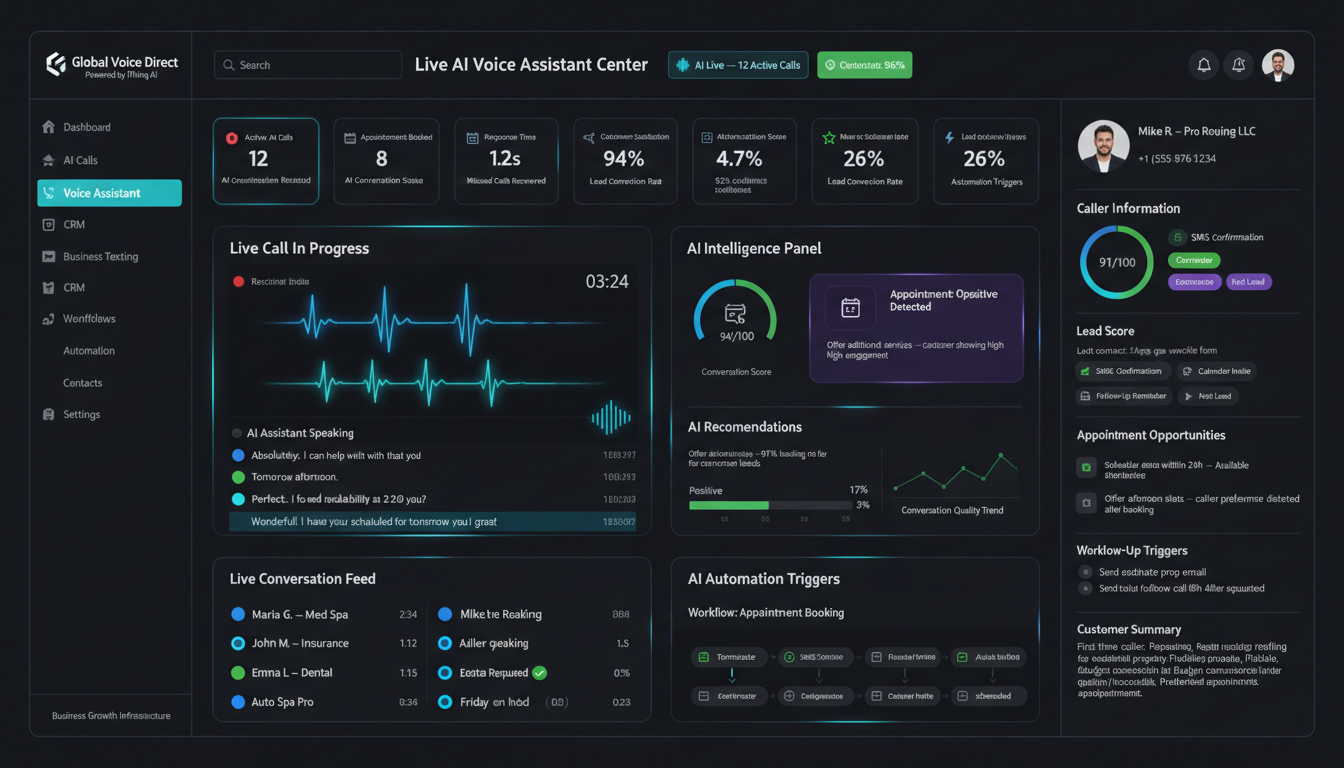
AI communication refers to using artificial intelligence to automate, enhance, and accelerate how businesses interact with customers. It covers phone systems, chatbots, follow-up automation, and more.
Customer expectations for speed, availability, and responsiveness are rising because the best experiences set the standard for every experience. AI gives businesses the infrastructure to meet that standard.
The businesses that adapt to this shift — thoughtfully, with the right systems — will be better positioned to grow. The businesses that ignore it will fall further behind.
Customer expectations have changed.
People want answers faster. They want help sooner. They expect businesses to be available more often.
This is not a trend. It is a permanent shift driven by technology, shaped by competition, and enforced by the market.
AI is changing how businesses communicate. The businesses that adapt will often create better customer experiences. The businesses that do not will lose customers to those that do.
This article explains how AI is reshaping communication, why customer expectations keep rising, and what businesses should do to prepare. It introduces the AI Communication Evolution Framework™ — a practical model for understanding where your business is and where you need to go.
What Is AI Communication?
AI communication is the use of artificial intelligence to handle, automate, or enhance how a business interacts with customers, prospects, and partners.
It is not one tool. It is a category of technologies that work together to make business communication faster, more consistent, and more scalable.
AI Communication
Any technology that uses artificial intelligence to send, receive, route, or respond to business communications without requiring full manual effort.
Conversational AI
Software that understands and responds to human language in real time. It powers chatbots, AI phone agents, and automated messaging systems that feel like natural conversation.
Communication Automation
Using software to automatically trigger, send, and manage business messages — including follow-ups, reminders, and notifications — based on customer actions or timelines.
Customer Communication Technology
The full set of tools and platforms a business uses to connect with customers. AI has made this category significantly more powerful and accessible for businesses of all sizes.
Why Customer Expectations Are Changing
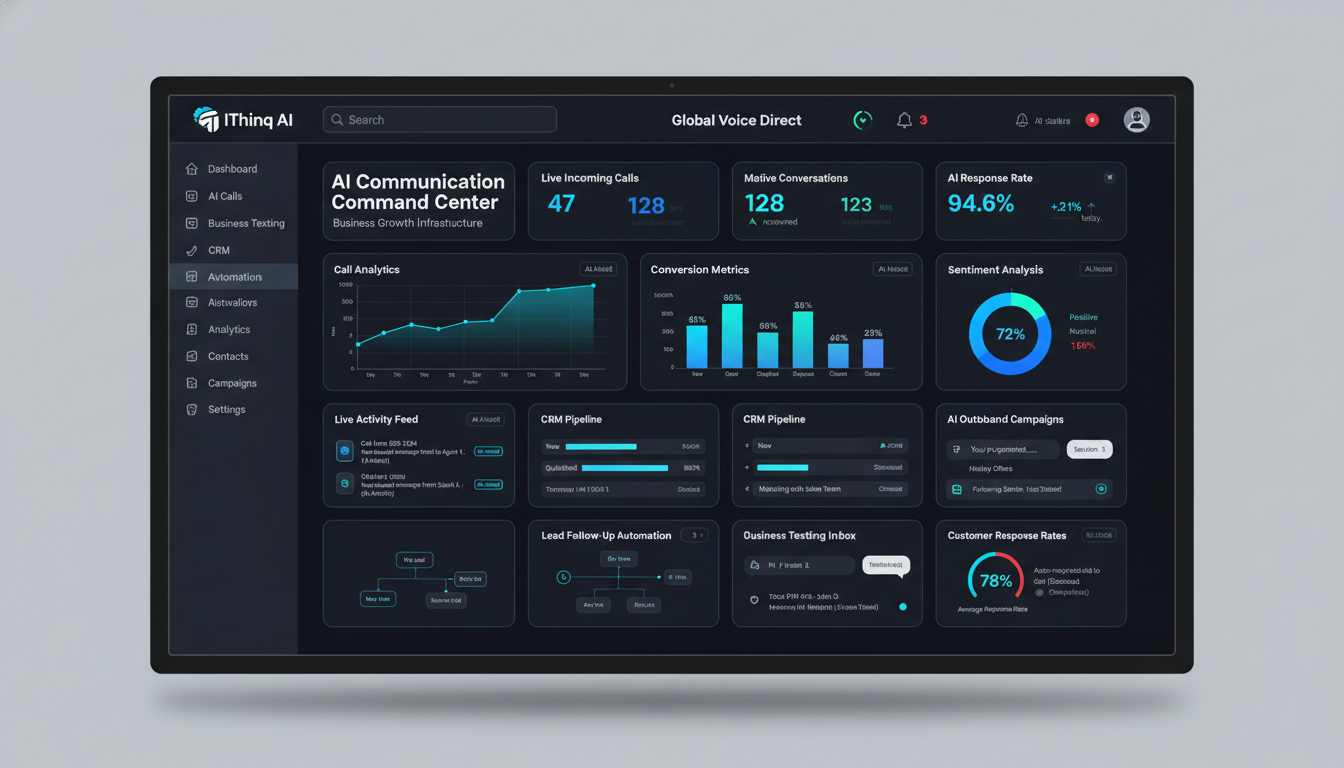
Expectations are not set in isolation. They are set by the best experience a customer has ever had — with any business, anywhere.
When someone gets an instant answer from one company, they expect the same from yours. When a competitor responds in seconds, your five-hour reply feels like neglect.
Four forces are driving this shift:
Speed
Customers expect immediate responses. Research consistently shows that the first business to respond to an inquiry wins the majority of the time. Waiting hours — or even 30 minutes — is now a competitive disadvantage.
Convenience
Customers want to reach businesses on their terms — by phone, text, chat, or email — without being forced into a single channel. The businesses that adapt to how customers prefer to communicate grow faster.
Accessibility
Customers call at night. They email on weekends. They text during their lunch break. Availability is no longer a bonus — it is an expectation, particularly as AI makes 24/7 service achievable for businesses of any size.
Responsiveness
Responsiveness is more than speed — it is consistency. Customers expect every interaction to be followed up, every question to be answered, every promise to be kept. AI makes that consistency possible at scale.
The AI Communication Evolution Framework™
Not every business is at the same stage of communication development. This framework maps five distinct stages — from purely reactive to fully predictive — so you can identify where your business is today and what the next step looks like.
| Stage | Name | Description | Example |
|---|---|---|---|
| Stage 1 | Reactive Communication |
Business responds only when contacted. No systems in place. Entirely dependent on staff availability. | Someone calls. If you are there, you answer. If not, they leave a voicemail — or call a competitor. |
| Stage 2 | Digital Communication |
Business uses email, websites, and social media to receive inquiries. Response still manual but volume increases. | Contact form on a website. Email inbox. Social media DMs. All handled by staff one message at a time. |
| Stage 3 | Automated Communication |
Business uses automation tools to trigger messages, reminders, and follow-ups without manual effort each time. | Appointment reminders sent automatically. Lead follow-up email sequence triggered when someone fills out a form. |
| Stage 4 | AI-Assisted Communication |
AI handles inbound and outbound communications. Human team focuses on judgment, strategy, and relationship-building. | AI answers calls 24/7. AI qualifies leads. Humans handle exceptions and complex situations. |
| Stage 5 | Predictive Communication |
AI anticipates customer needs and initiates contact before the customer asks — based on behavioral signals and history. | AI detects a customer has not reordered a service they use regularly and sends a proactive outreach automatically. |
The Rise Of 24/7 Expectations
There was a time when a business being closed after 5pm was acceptable. That time is gone.
Customers now call, text, and inquire at all hours — not because they are being unreasonable, but because their own schedules demand it. A parent inquiring about a service after the kids go to bed at 9pm is not unusual. A small business owner researching vendors at 11pm is not unusual. These are normal behaviors driven by busy lives.
The businesses that build communication systems capable of responding at all hours capture these opportunities. The businesses that cannot capture them, lose them.
Businesses like Global Voice Direct exist specifically to solve this problem — providing communication infrastructure that allows businesses to respond to customers around the clock without requiring staff to be available at all hours. This is what modern communication infrastructure looks like in practice: systems that work even when people cannot.
How AI Is Improving Business Communication
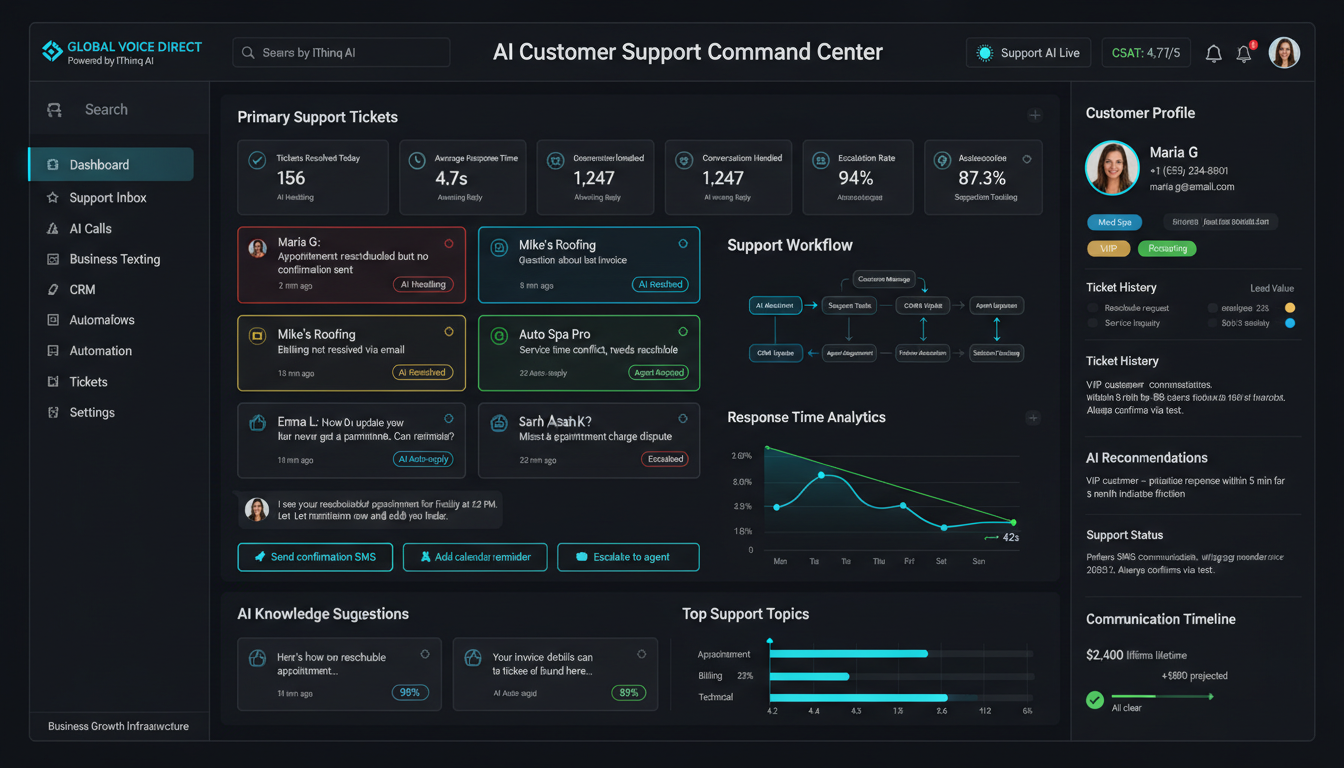
AI is not improving communication by replacing humans. It is improving communication by removing the bottlenecks that humans create at scale.
Four areas where AI creates measurable improvement:
Response Speed
AI responds in seconds, not hours. Every inbound inquiry — phone, chat, or message — gets an immediate acknowledgment and often a complete answer without a human having to be involved.
Customer Engagement
AI systems can handle higher volumes of simultaneous conversations than any human team. This means no customer waits in a queue, no lead gets dropped, and no opportunity is missed due to capacity.
Follow-Up Consistency
AI never forgets to follow up. Leads that would have gone cold in a manual system get automated outreach at the right moment — without relying on a sales team to remember.
Communication Consistency
AI delivers the same quality of interaction on the 100th conversation as the first. No bad days. No inconsistent messaging. No variation in tone or professionalism due to staff turnover.
Platforms like IThinq AI are building the AI-enhanced communication workflows that allow businesses to operate at this level — making enterprise-grade communication accessible to growing companies without requiring enterprise-sized teams.
The Human + AI Model™
The conversation about AI in business communication often gets framed as a conflict: humans versus machines. That framing is wrong.
The future is not humans or AI. The future is humans plus AI.
AI handles speed and scale. Humans handle judgment and relationships. When you combine both, you get something better than either could produce alone.
What AI Does Well
- Responds instantly at any hour
- Handles high volumes simultaneously
- Maintains perfect consistency
- Never forgets a follow-up
- Scales without additional cost
- Captures data on every interaction
What Humans Do Well
- Build genuine relationships
- Apply empathy in complex moments
- Make judgment calls with nuance
- Set strategy and vision
- Resolve exceptions and edge cases
- Create trust through authentic care
The most effective businesses use AI to remove the friction from communication — so their human team can spend their energy where it matters most. Efficiency and empathy are not opposites in this model. They are partners.
What Businesses Should Automate
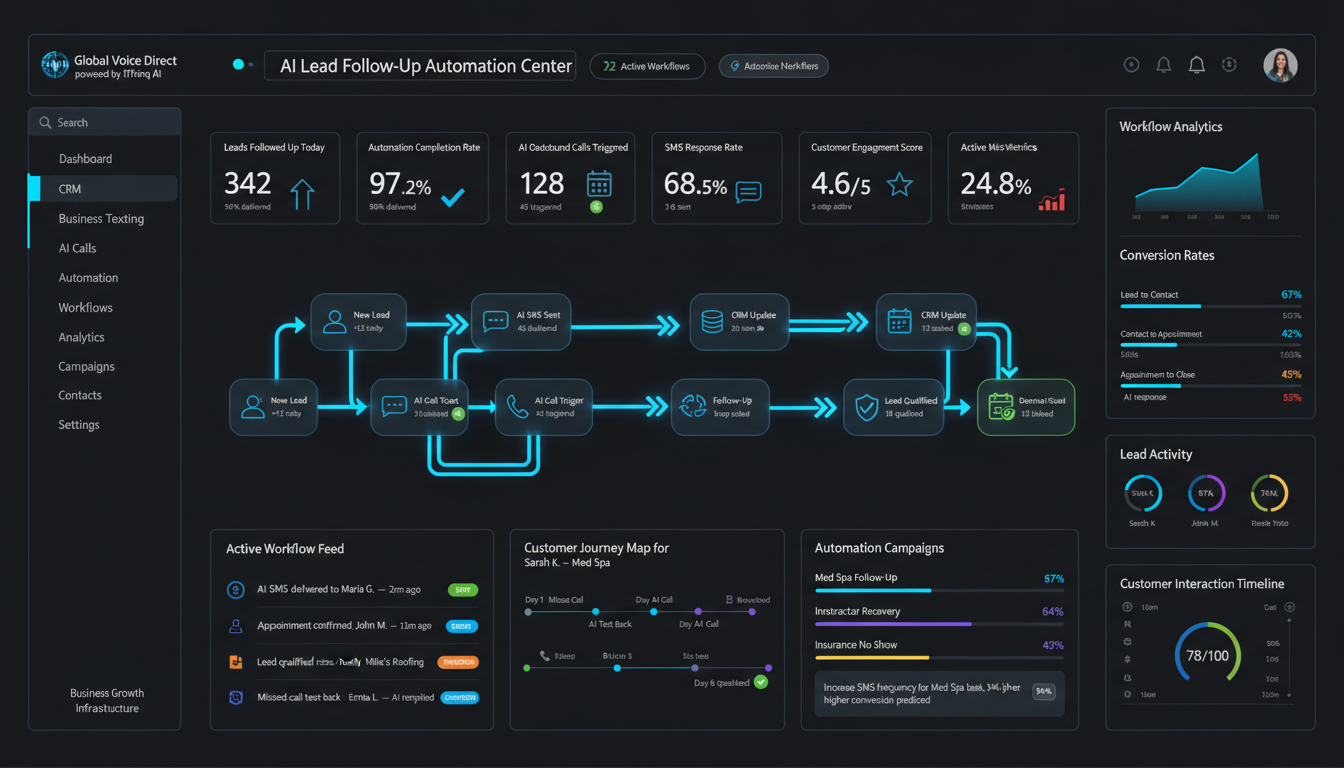
Automation works best for high-volume, low-complexity communications that follow a predictable pattern. These interactions do not require human judgment — they require reliability and speed.
-
Frequently Asked Questions Hours of operation, pricing, services, location, availability. These are answered the same way every time. AI handles them in seconds without tying up staff.
-
Appointment Reminders Automated reminders reduce no-shows, improve customer satisfaction, and save significant staff time — especially for service-based businesses.
-
Lead Follow-Up Speed to contact is one of the strongest predictors of conversion. AI follow-up systems reach new leads in seconds, dramatically improving contact rates and sales outcomes. This connects directly to concepts in lead management that we explore in AI For Lead Follow-Up: Why Speed And Consistency Matter More Than Ever.
-
Customer Notifications Order confirmations, status updates, service completion notices, and payment confirmations. All predictable. All automatable. All valuable for customer experience.
-
Inbound Call Routing AI phone systems can answer, qualify, and route inbound calls 24 hours a day — ensuring no call goes unanswered and every caller reaches the right person or gets the information they need.
What Should Remain Human
Automation has limits. There are categories of communication where human presence is not just preferred — it is essential.
Leadership & Vision
The conversations that set the direction of a business — with partners, key clients, and teams — require human judgment and authentic commitment. No AI can replace this.
Strategic Relationships
High-value partnerships, major client accounts, and long-term customer relationships require human investment. AI can support these relationships, but the core of them must be human.
Complex Problem-Solving
When a customer has a problem that falls outside standard patterns — something unexpected, sensitive, or nuanced — human empathy and judgment are irreplaceable.
Trust-Building
Trust is ultimately built person to person. AI can maintain and reinforce trust through consistency, but the deepest trust — especially in service businesses — comes from human care.
The goal of AI communication is not to remove humans from the equation. It is to free humans from the tasks that do not require them — so they can focus on the ones that do. This is a core principle of the Entrepreneur Infrastructure Model™.
Common AI Communication Mistakes
AI communication done wrong creates the same problems it is supposed to solve — frustrated customers, missed leads, and damaged trust. Here are the most common mistakes businesses make.
-
Removing Human Interaction Completely
AI should supplement human communication, not replace it entirely. Customers who cannot reach a human when they need one become former customers. Always maintain a path to a real person.
-
Poor Implementation
An AI system that gives wrong answers, misroutes callers, or fails to understand basic requests creates more frustration than no system at all. Implementation quality determines whether AI helps or hurts.
-
Over-Automation of Sensitive Conversations
Billing disputes, complaints, and high-stakes service failures should escalate to humans quickly. Keeping customers locked in automated loops during these moments causes serious brand damage.
-
Ignoring the Customer Experience After Automation
Many businesses implement AI and then stop measuring the customer experience. Automation should be monitored, tested, and refined regularly based on real customer feedback and interaction data.
AI Communication Audit™
Use this checklist to evaluate where your business stands today. Honest answers here will reveal your most important next steps.
-
Availability Audit Can a customer reach your business or get basic information outside of business hours? If not, how many inquiries are you missing weekly?
-
Response Time Audit What is your average time from first contact to first response? Anything over 5 minutes on a phone inquiry or 1 hour on a digital inquiry is a conversion risk.
-
Follow-Up Audit What happens to a lead that does not convert immediately? Is there a systematic follow-up sequence, or does it depend on a staff member remembering?
-
Consistency Audit If five different staff members answered the same customer question this week, would the answers be consistent? AI creates that consistency automatically.
-
Scalability Audit If your inquiry volume doubled tomorrow, would your communication systems keep up? Or would quality degrade as the team got overwhelmed?
-
Channel Audit Can customers reach your business by phone, email, and digital message? Are all three channels actively monitored and responded to in a reasonable timeframe?
Technology Changes. Human Expectations Don’t.
I have built businesses across multiple industries. And one truth has held constant across all of them: the businesses that communicate well win.
Not the ones with the best product. Not always the ones with the lowest price. The ones that respond quickly, follow up consistently, and make customers feel like they matter.
AI changes the tools we use to do that. It does not change the underlying expectation.
Customers still want to feel heard. They still want to trust the businesses they work with. They still want their problems solved and their time respected. AI just makes it possible to deliver on those expectations at a scale and consistency that was not achievable before.
Communication is still a trust-building activity. AI is the infrastructure that makes trust-building possible at scale. Businesses that understand this distinction will build lasting competitive advantages. Businesses that treat AI as a cost-cutting replacement for human care will eventually learn otherwise.
The future of communication is faster, smarter, and more helpful — but it is still, at its core, human.
AI Communication Readiness Score™
Score your business across five dimensions. Each category is worth up to 20 points. Your total score out of 100 tells you where you stand — and where to invest first.
Frequently Asked Questions
What is AI communication?
AI communication is the use of artificial intelligence to handle, automate, or enhance how businesses interact with customers across phone, chat, email, and digital channels.
How is AI changing customer service?
AI is enabling faster response times, 24/7 availability, and more consistent customer interactions without requiring additional staff.
Will AI replace human communication?
No. AI handles routine tasks while humans focus on strategy, relationships, and complex problem-solving. The future is humans plus AI, not AI instead of humans.
What communication should businesses automate?
FAQs, appointment reminders, lead follow-up, order confirmations, and customer notifications are strong candidates for automation.
What are AI communication tools?
AI communication tools include AI phone systems, chatbots, automated follow-up platforms, conversational AI assistants, and AI-enhanced CRM workflows.
What is the future of customer communication?
The future is faster, more accessible, and more personalized communication powered by AI systems working alongside human teams.
What is conversational AI?
Conversational AI refers to technology that can understand and respond to human language naturally, enabling real-time dialogue between customers and automated systems.
Why do customer expectations keep rising?
Customers set their expectations by the best experience they have ever had. As leading businesses adopt faster and smarter communication, every business is held to the same standard.
What is communication automation?
Communication automation uses software and AI to send, route, and respond to messages without requiring manual effort from a human team member.
How does AI improve response speed?
AI systems respond instantly to inbound inquiries, eliminating hold times and delays that frustrate customers and cost businesses leads.
What is the AI Communication Evolution Framework™?
The AI Communication Evolution Framework™ is a five-stage model developed by Jonas Janvier that maps how businesses progress from reactive communication to predictive AI-driven communication.
What is predictive communication?
Predictive communication is when a business anticipates customer needs and reaches out proactively before the customer asks — powered by AI and behavioral data.
What is the Human + AI Model™?
The Human + AI Model™ describes a business communication approach where AI handles speed and scale while humans provide empathy, judgment, and relationship-building.
What communication mistakes do businesses make with AI?
Common mistakes include removing human interaction entirely, poor AI implementation, over-automating sensitive conversations, and neglecting the customer experience after automation.
How do I know if my business is ready for AI communication?
Use the AI Communication Readiness Score™ to evaluate your business across five dimensions: Accessibility, Responsiveness, Automation, Customer Experience, and Communication Systems.
What is an AI phone system?
An AI phone system uses artificial intelligence to answer, route, and respond to calls automatically, ensuring customers always reach someone even outside business hours.
How does AI affect small business communication?
AI gives small businesses enterprise-level communication capabilities without the overhead of a large staff, leveling the playing field with bigger competitors.
What is business communication technology?
Business communication technology includes any system, platform, or tool that helps a company send, receive, route, or manage communications with customers and prospects.
What should remain human in business communication?
Leadership decisions, strategy conversations, complex problem-solving, trust-building, and relationship management should remain human-led.
How does communication infrastructure affect business growth?
Strong communication infrastructure ensures no lead is missed, no customer is ignored, and every interaction builds trust — directly supporting revenue and retention.
The Future Of Communication Is Faster, Smarter, And More Helpful
Businesses that combine strong communication systems with thoughtful technology adoption will be better positioned to serve customers in the years ahead.
The frameworks in this article — the AI Communication Evolution Framework™, the Human + AI Model™, and the AI Communication Readiness Score™ — are part of a broader Business Infrastructure Framework™ designed to help entrepreneurs build businesses that run on systems, not just effort.
Explore related topics: Communication Systems Framework™ · Entrepreneur Infrastructure Model™ · Startup Operating System™