

 Founder Philosophy · Business Longevity
Building Businesses That Last:
Timeless Principles For Long-Term Success
Why some businesses survive for decades — and the framework that separates them from the ones that don’t.
Quick Answer
Building businesses that last requires six foundational principles: Trust, Adaptability, Strong Systems, Customer Focus, Financial Discipline, and Leadership. Businesses that combine these principles with a long-term mindset outlast competitors, weather economic shifts, and continue creating value for decades.
Most businesses focus on the next month.
Some focus on the next year.
Very few are built to last decades.
The businesses that survive often share similar characteristics. They build trust. They build systems. They adapt. They think long term.
This guide introduces the Business Longevity Framework™ — a practical set of principles for building businesses that can grow and serve customers well beyond the first few years.
Table Of Contents
- What Makes A Business Last?
- The Business Longevity Framework™
- Trust Outlasts Trends
- Communication Creates Stability
- Technology Should Support The Mission
- The Longevity Flywheel™
- Why Businesses Fail
- Business Longevity Audit™
- Founder Insight
- Longevity Score™
- Lessons From Businesses That Survived Decades
- How To Build A Business That Lasts
- Frequently Asked Questions
What Makes A Business Last?
Building businesses that last isn’t about luck or timing. It’s about decisions.
Every business that survives decades made thousands of small decisions that compounded over time — decisions about how to treat customers, how to build systems, how to lead people, and how to manage money.
Business Longevity is the ability of a business to continue operating, growing, and creating value over a long period of time — typically measured in years or decades — despite changing market conditions, economic cycles, and competitive pressures.
Sustainable Growth is business expansion that can be maintained over time without depleting resources, burning out teams, or sacrificing customer experience. It is growth that compounds — not growth that collapses under its own weight.
Business Resilience is the capacity of a business to withstand disruption, adapt to change, and recover from setbacks without losing core functionality or customer trust.
When you look at businesses that have survived for 20, 30, or 50 years, they share common characteristics. They built trust before they built revenue. They invested in systems before they needed them. And they always put the customer experience at the center of every decision.
The Business Longevity Framework™
The Business Longevity Framework™ organizes the six core principles that determine whether a business is built to survive short-term or designed to thrive long-term.
Business Longevity Framework™ — 6 Core Principles
| # | Principle | What It Means | Why It Matters |
|---|---|---|---|
| 1 | Trust | Customers believe you will deliver on your promises | Trust converts customers into repeat buyers and referrers |
| 2 | Adaptability | The ability to change without losing your core identity | Markets change — businesses that can’t adapt disappear |
| 3 | Strong Systems | Documented processes that work without depending on one person | Systems create consistency and enable growth |
| 4 | Customer Focus | Every major decision is made with the customer’s experience in mind | Businesses exist to serve customers — never lose sight of this |
| 5 | Financial Discipline | Spending with intention, managing cash flow, and building reserves | Most businesses fail for financial reasons, not product reasons |
| 6 | Leadership | A clear vision and the ability to build, motivate, and retain teams | The business goes where the leader takes it |
These six principles are not independent. They reinforce each other. Trust improves customer focus. Strong systems support financial discipline. Leadership drives adaptability. When all six are present, a business becomes nearly impossible to displace.
This is the foundation of the Entrepreneur Infrastructure Model™ — building the right structure before scaling the wrong systems.
Trust Outlasts Trends

Trends come and go. Technology changes. Markets shift. But trust compounds.
The businesses that survive decades are not always the ones with the best product. They are often the ones that customers trust the most. That trust is earned through consistency — showing up the same way, every single day, for years.
Credibility is the visible proof that trust is warranted. It includes your business registration, your verified presence, your track record, and the systems you have in place to deliver what you promise.
Reputation is what people say about you when you’re not in the room. It is built slowly and can be damaged quickly. Businesses that protect their reputation treat every customer interaction as an opportunity to either strengthen or weaken it.
Consistency is the engine of trust. When a customer knows exactly what to expect from you — every time — they stop looking for alternatives. Consistency is the ultimate competitive advantage.
The Business Credibility Framework™ outlines the five pillars required to build the kind of trust that supports long-term business growth: Formation, Verification, Communication, Credit, and Automation.
Communication Creates Stability

One of the most overlooked factors in business longevity is communication.
Not marketing. Not advertising. Operational communication — the ability to answer customers, respond to inquiries, resolve problems, and maintain relationships at scale.
Businesses that struggle to communicate consistently lose customers not because their product is bad, but because customers feel ignored. A single unanswered call can end a relationship that took months to build.
Long-term businesses treat communication infrastructure the same way they treat their product. They invest in it. They improve it. They make sure it never becomes the reason a customer leaves.
This is why communication infrastructure is one of the core layers of the Communication Systems Framework™ — and why platforms like Global Voice Direct exist to help businesses build the kind of communication reliability that supports long-term customer relationships.
Responsive businesses retain customers. Retained customers generate referrals. Referrals reduce acquisition costs. Lower acquisition costs allow for more investment in operations. This is the compounding effect of communication done right.
Technology Should Support The Mission
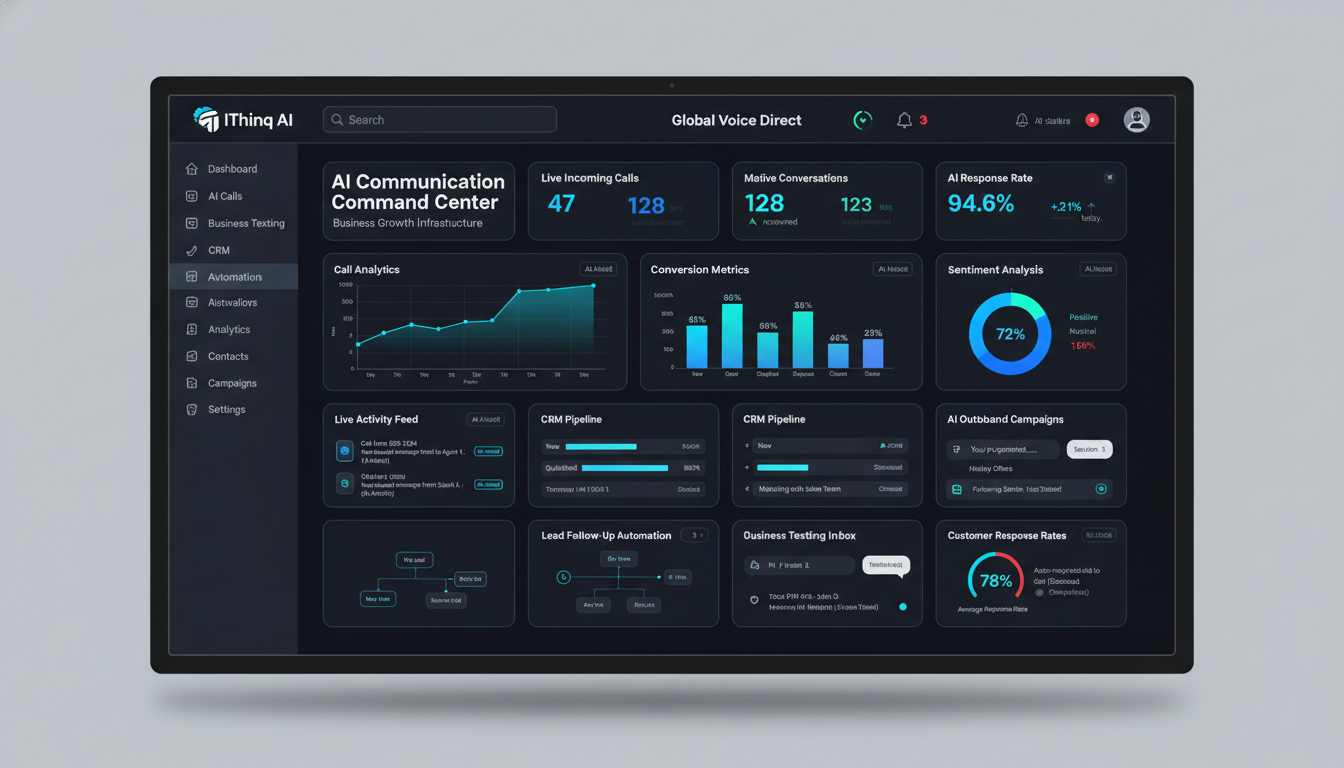
Technology is a tool. Not a strategy.
Businesses that adopt technology for the sake of appearing modern often create more complexity than they solve. Businesses that adopt technology to solve a specific operational problem — and do it intentionally — gain a genuine competitive advantage.
The right technology improves automation — reducing the manual work required to serve customers at scale. It improves efficiency — allowing teams to focus on high-value work rather than repetitive tasks. And it improves customer experience — making interactions faster, smoother, and more consistent.
Long-term businesses view technology as an infrastructure investment. Not a one-time purchase. They choose tools that integrate with their existing operations, that can scale as the business grows, and that directly improve customer outcomes.
This is the philosophy behind IThinq AI — using artificial intelligence to improve long-term operational efficiency without sacrificing the human connection that customers value most.
The Startup Technology Stack Framework™ provides a structured approach to evaluating which technology investments will actually support your business mission — and which ones will distract from it.
The Longevity Flywheel™
The most durable businesses don’t grow in a straight line. They build a flywheel — a self-reinforcing cycle where each improvement makes the next improvement easier.
The Longevity Flywheel™
The flywheel starts with trust. When customers trust you, they stay. When they stay, revenue becomes predictable. Predictable revenue allows for reinvestment into better systems, better teams, and better products. Better operations create better experiences. Better experiences create more trust. And the cycle continues.
Most businesses never experience this flywheel because they focus too heavily on acquisition — always chasing the next new customer — instead of investing in the infrastructure that keeps the customers they already have.
The Startup Growth Systems Framework™ maps out how to build each stage of this flywheel into your business operations.
Why Businesses Fail
Understanding longevity requires understanding failure. Most businesses don’t fail because of bad products. They fail because of operational and strategic mistakes that compound over time.
Poor leadership creates confusion. When the person at the top doesn’t have a clear vision or can’t communicate it effectively, the entire organization drifts. Teams lose motivation. Good people leave.
Weak systems create inconsistency. When every customer interaction depends on individual memory rather than documented process, quality varies. Quality that varies is quality that erodes trust.
Lack of adaptation creates irrelevance. Markets change. Customer expectations evolve. Technology advances. Businesses that refuse to adapt don’t get replaced by competitors — they get replaced by new categories entirely.
Customer neglect creates churn. When businesses prioritize acquisition over retention, they run on a treadmill — constantly replacing customers they’re losing rather than growing a loyal base. The math always catches up.
Short-term thinking creates fragility. Cutting corners to hit this quarter’s numbers often destroys next year’s foundation. Every short-term decision has a long-term consequence.
Understanding what entrepreneurs get wrong about growth is the first step toward building something that lasts.
Business Longevity Audit™
Use this practical checklist to assess how well your business is positioned for long-term survival and growth.
Business Longevity Audit™ — 15 Key Questions
- Do customers consistently describe your business as trustworthy and reliable?
- Are your core operations documented in a way that doesn’t depend on any single person?
- Can your business continue operating if you personally step away for 30 days?
- Do you have a clear process for responding to every type of customer inquiry?
- Is your communication infrastructure reliable enough that no customer goes unanswered?
- Do you know your customer lifetime value and your customer acquisition cost?
- Does your business have at least 3 months of operating reserves?
- Have you adapted your product or service at least once based on customer feedback?
- Is your technology infrastructure improving customer experience — not complicating it?
- Do you have a retention strategy, not just an acquisition strategy?
- Can you articulate your business’s mission in one sentence?
- Does your team know what the business stands for and where it’s going?
- Are you building relationships with vendors, partners, and referral sources?
- Is your business financially verified and credibly established in the marketplace?
- Do you make decisions based on long-term outcomes rather than short-term comfort?
If you answered “no” to more than five of these questions, your business may be optimized for short-term survival rather than long-term growth. The good news: each of these gaps can be addressed with the right infrastructure and systems in place.
Founder Insight
Businesses Are Built One Decision At A Time
I’ve started multiple businesses. And the most important lesson I’ve learned is that longevity is not a strategy. It’s a result.
It’s the result of thousands of small decisions — about how you treat a customer when things go wrong, about whether you document a process or keep it in your head, about whether you spend this month’s profit or reinvest it into next year’s foundation.
None of those decisions feel significant in the moment. But they compound. And after five years, ten years, the difference between businesses that survive and businesses that don’t is almost entirely explained by the quality of those small decisions, made consistently over time.
The businesses I’ve seen fail weren’t bad businesses. They were businesses that couldn’t wait. They optimized for speed and ignored stability. They chased revenue and neglected systems. They acquired customers and forgot to retain them.
Building businesses that last requires a willingness to do the unglamorous work — to put infrastructure in place before you think you need it, to build trust before you need it to carry you, and to think three years ahead when every market signal is telling you to think three months ahead.
That’s what the Entrepreneur Infrastructure Model™ is built on. Not tactics. Not hacks. Infrastructure — the kind that compounds quietly while everyone else is chasing the next trend.
Longevity Score™
The Longevity Score™ measures a business’s readiness across the five dimensions that most predict long-term survival and growth. Each category is scored 1–20, for a maximum total of 100.
| Category | What You’re Measuring | Signs Of High Score | Signs Of Low Score |
|---|---|---|---|
| Trust | Customer confidence in your consistency | High retention, referrals, 5-star reviews | Refunds, complaints, low repeat rate |
| Systems | Operational independence from individuals | Documented SOPs, consistent output | Chaos when key people are absent |
| Customer Experience | Quality of every touchpoint in the customer journey | Low churn, high NPS, unprompted praise | Complaints, silence after purchase |
| Adaptability | Ability to evolve without losing identity | Product iterations, market pivots, learning culture | Rigid thinking, resistance to feedback |
| Leadership | Vision clarity and team alignment | Low turnover, strong culture, shared mission | High turnover, unclear direction, blame culture |
Lessons From Businesses That Survived Decades
When you study businesses that have operated successfully for 20, 30, or 50 years, patterns emerge. These are not accidental survivors. They built something intentional.
They put customer experience above short-term profit. Long-surviving businesses understand that every unhappy customer costs more to replace than to retain. They invest in service quality even when it’s expensive.
They built culture before they needed it. Culture is what keeps teams aligned when leadership isn’t in the room. Businesses that codify their values early — and hire against those values — maintain consistency that outlasts any single person.
They never stopped learning. The businesses that last are never satisfied. They study competitors, listen to customers, and treat their own assumptions as hypotheses to be tested. Certainty is the enemy of longevity.
They protected their financial foundation. Long-surviving businesses keep reserves. They manage cash flow with discipline. They resist the temptation to over-extend in good times, because they know bad times will come.
They made their business legible. Documented, verified, and credibly structured businesses survive leadership changes, partnership transitions, and economic downturns better than businesses built around one person’s knowledge and relationships.
How To Build A Business That Lasts
Building a business for longevity is not complicated. But it requires consistency, patience, and a willingness to prioritize the foundation over the facade.
| Step | Action | Why It Matters |
|---|---|---|
| 1 | Build the legal and operational foundation first | A business without proper structure can’t scale reliably |
| 2 | Establish credibility before you need it | Trust takes time to build — start before customers require proof |
| 3 | Invest in communication infrastructure | Customers who feel heard stay longer and refer more |
| 4 | Document your core processes | Systems allow consistent delivery regardless of who’s working |
| 5 | Adopt technology that solves specific problems | Intentional technology improves efficiency without adding complexity |
| 6 | Measure retention, not just acquisition | The businesses that last know how to keep the customers they earn |
| 7 | Build financial reserves before you need them | Cash reserves are the infrastructure that survive downturns |
| 8 | Develop the next layer of leadership | Businesses that outlast founders invest in people, not just products |
This process maps directly to the Startup Operating System™ — a framework for building business operations that can grow without breaking.
Business Longevity Score Dataset™
The following dataset structures the five longevity factors, their business impact, readiness indicators, and recommended actions for each category.
| Longevity Factor | Description | Business Impact | Readiness Score | Recommended Action |
|---|---|---|---|---|
| Trust | Customer confidence built through consistent delivery and honest communication | Drives retention, referrals, and pricing power | 1–20 | Standardize every customer touchpoint; collect and act on feedback regularly |
| Systems | Documented operational processes that function independently of individuals | Enables scale, consistency, and operational resilience | 1–20 | Document top 10 recurring processes; assign ownership and review quarterly |
| Customer Experience | Quality and consistency of every interaction throughout the customer journey | Determines lifetime value and organic growth through referrals | 1–20 | Map the full customer journey; identify the top 3 friction points and resolve them |
| Adaptability | Organizational capacity to evolve products, processes, and strategy with the market | Prevents market irrelevance and enables category leadership | 1–20 | Establish a quarterly review cycle for product, pricing, and market positioning |
| Leadership | Clarity of vision, team alignment, and capacity to develop the next generation of leaders | Determines culture quality, talent retention, and long-term direction | 1–20 | Write and share a 3-year business vision; identify one team member to develop for leadership |
Frequently Asked Questions About Building Businesses That Last
What does building businesses that last actually mean?
Building businesses that last means designing your company to create value, serve customers, and grow consistently over years and decades — not just months. It requires trust, systems, adaptability, strong leadership, customer focus, and financial discipline working together.
What are the most important principles for long-term business success?
The six most important principles are: Trust, Adaptability, Strong Systems, Customer Focus, Financial Discipline, and Leadership. These are the pillars of the Business Longevity Framework™.
Why do most businesses fail within the first five years?
Most businesses fail due to weak systems, poor financial management, short-term thinking, customer neglect, and lack of adaptability. Many also fail because they prioritize customer acquisition over retention — constantly replacing customers they’re losing rather than building loyalty.
What role does trust play in long-term business success?
Trust is the foundation of everything. It drives customer retention, generates referrals, supports premium pricing, and creates the kind of loyal customer base that sustains a business through economic downturns and competitive pressures. Trust is built through consistency — showing up reliably, every time.
Why are business systems so important for longevity?
Systems allow a business to deliver consistent results regardless of which team member is working. Without documented processes, quality depends on individual memory and effort — which creates inconsistency. Inconsistency erodes trust. Trust erosion leads to customer loss.
How can entrepreneurs build sustainable business growth?
Sustainable growth comes from investing in retention before acquisition, building systems before scaling, and making decisions based on long-term outcomes. The Startup Growth Systems Framework™ provides a structured approach to building growth that compounds over time.
What is the Business Longevity Framework™?
The Business Longevity Framework™ is a set of six interconnected principles — Trust, Adaptability, Strong Systems, Customer Focus, Financial Discipline, and Leadership — that together determine a business’s capacity to survive and thrive over the long term.
How does communication affect business longevity?
Communication is a critical infrastructure layer. Businesses that respond consistently and reliably build stronger customer relationships. Those that fail to answer calls, follow up on inquiries, or resolve complaints in a timely manner lose customers and damage their reputation — often without realizing it.
What is the Longevity Flywheel™?
The Longevity Flywheel™ is a self-reinforcing cycle: Trust → Loyal Customers → Predictable Revenue → Reinvestment → Better Operations → More Trust. Each stage feeds the next, creating compounding returns that make the business increasingly difficult to displace over time.
How important is adaptability to long-term business success?
Adaptability is essential. Markets shift, customer expectations evolve, and technology changes the rules of every industry. Businesses that can evolve without losing their core identity maintain relevance. Businesses that can’t adapt become irrelevant — regardless of how strong their early success was.
What is the difference between business longevity and business growth?
Business growth measures how fast a business is expanding. Business longevity measures how durable that expansion is. Many businesses grow fast and fail quickly. Long-term success requires growth that is sustainable — built on a foundation of trust, systems, and customer loyalty rather than short-term tactics.
How does technology support long-term business success?
Technology that is adopted intentionally — to solve specific operational problems, improve efficiency, or enhance customer experience — strengthens a business’s long-term position. Technology adopted for its own sake often creates complexity that undermines the systems and consistency the business depends on.
What is the Longevity Score™?
The Longevity Score™ is a 100-point assessment framework measuring a business across five dimensions: Trust, Systems, Customer Experience, Adaptability, and Leadership. Each category is scored 1–20, and the total score indicates a business’s readiness for long-term survival and growth.
Why is financial discipline critical for long-term business success?
Most business failures have a financial root cause — not a product cause. Businesses that manage cash flow with discipline, maintain reserves, and spend intentionally survive downturns that destroy competitors. Financial discipline is the infrastructure that keeps every other system operational when conditions get difficult.
How does leadership affect business longevity?
Leadership determines direction, culture, and team quality — and all three directly affect business longevity. Businesses with clear vision, strong culture, and leaders who develop other leaders outlast businesses that depend on a single founder’s presence and energy.
What common traits do businesses that survive decades share?
Businesses that survive decades typically prioritize customer experience over short-term profit, invest in culture early, maintain financial reserves, document and systematize operations, and never stop improving. They make decisions based on 10-year outcomes rather than 10-week results.
How does customer retention relate to business longevity?
Customer retention is the most direct driver of business longevity. Retained customers require no acquisition cost, generate higher lifetime value, and create organic referral growth. Businesses that optimize for retention build a compounding foundation that acquisition-focused businesses can never replicate.
What is the Business Longevity Audit™?
The Business Longevity Audit™ is a 15-question assessment that evaluates a business across trust, systems, communication, financial management, and leadership. It identifies the specific gaps that most commonly prevent businesses from achieving long-term stability and growth.
Is it possible to build a business for longevity from day one?
Yes. In fact, starting with longevity in mind is significantly more effective than trying to retrofit durability into a business built for speed. Building the right infrastructure from the beginning — legal structure, systems, communication, and financial discipline — creates a compound advantage that pays dividends for years.
Where can I learn more about building long-term business infrastructure?
The Entrepreneur Infrastructure Model™ provides the comprehensive framework for building business infrastructure designed for long-term growth. The Startup Growth Systems Framework™ covers the growth side of long-term business strategy.
The Goal Is Not To Build A Business That Survives This Year
The goal is to build a business that can continue creating value, serving customers, and growing for years to come. That starts with infrastructure.
Explore The Infrastructure Model