

The Business Trust Framework: How Companies Earn Credibility, Loyalty, And Long-Term Growth
Trust is not a feature. It is the foundation every sustainable business is built on.

What Is the Business Trust Framework?
The Business Trust Framework™ is a six-pillar system that explains how businesses earn credibility, build customer confidence, and create the conditions for sustainable long-term growth. The six pillars are: Credibility, Communication, Consistency, Customer Experience, Proof, and Reputation. When all six work together, trust compounds — and trust is the engine behind referrals, retention, and revenue.
📋 Table of Contents
- What Is Business Trust?
- The Business Trust Framework™ — 6 Pillars
- Pillar 1: Credibility Creates Trust
- Pillar 2: Communication Builds Confidence
- Pillar 3: Consistency Builds Reputation
- Technology Supports Trust
- The Trust Flywheel™
- Common Trust Killers
- Business Trust Audit™
- Founder Insight: Trust Is Built In Small Moments
- Business Trust Score™
- How To Increase Business Trust
- Frequently Asked Questions
Businesses do not grow because people know they exist.
Businesses grow because people trust them.
Trust shapes buying decisions before a single word is spoken. It determines whether a customer leaves a five-star review, refers a friend, or comes back. It is the difference between a business that thrives and one that survives.
The Business Trust Framework™ is a practical system for understanding how trust is built, protected, and compounded over time. Every business — no matter the size or stage — is either building trust or losing it.
There is no middle ground.
What Is Business Trust?
Business trust is the confidence a customer, partner, or vendor has that a company will do what it says it will do. It is built over time through consistent actions, clear communication, and reliable delivery.
Business Trust
Business trust is the level of confidence that customers, partners, and the market have in a company’s ability to fulfill its commitments, communicate honestly, and deliver consistent value over time.
Business Credibility
Business credibility is the perception that a business is legitimate, qualified, and capable. It is established through verifiable proof points — proper formation, a professional presence, verified contact information, and demonstrated expertise.
Customer Confidence
Customer confidence is a buyer’s belief that a business will deliver on its promise before, during, and after a transaction. High customer confidence reduces hesitation and increases willingness to buy, refer, and return.
Brand Reputation
Brand reputation is what the market collectively believes about a business based on accumulated experiences, reviews, referrals, and public signals. Reputation is the long-term result of sustained trust-building behaviors.
These four elements are closely connected. Credibility earns the first opportunity. Trust earns the second. Confidence accelerates the decision. Reputation earns the referral.
The Business Trust Framework™ — 6 Pillars
The Business Trust Framework™ organizes the way businesses earn and sustain trust into six interconnected pillars. Each pillar reinforces the others.
📐 Framework Summary — Business Trust Framework™
Six pillars. One outcome: a business the market trusts enough to buy from, refer, and return to.
Credibility
The foundation. A business must look legitimate before it can earn trust. Proper formation, a professional website, verified contact info, and business email are non-negotiable.
Communication
Responsiveness signals respect. Businesses that answer calls, reply quickly, and communicate clearly earn confidence faster than those that go silent.
Consistency
Reputation is built one interaction at a time. Businesses that deliver the same quality experience every time earn the kind of trust that does not fade.
Customer Experience
Every touchpoint is a trust moment. From the first inquiry to post-sale support, customer experience determines whether a buyer becomes a repeat customer or a warning story.
Proof
Trust claims without evidence are just noise. Reviews, case studies, testimonials, and verifiable credentials turn credibility claims into credibility facts.
Reputation
Reputation is the cumulative result of the other five pillars. It is what the market says about a business when no one is selling — and it is the most durable competitive advantage available.
| Pillar | Core Question | Business Impact | Trust Level |
|---|---|---|---|
| Credibility | Does this business look legitimate? | First impression, vendor acceptance, funding access | Entry-level trust |
| Communication | Does this business respond? | Customer confidence, reduced drop-off | Confidence trust |
| Consistency | Does this business deliver every time? | Retention, loyalty, repeat business | Behavioral trust |
| Customer Experience | Does this business make me feel valued? | Reviews, referrals, lifetime value | Emotional trust |
| Proof | Can I verify this business’s claims? | Objection reduction, conversion rate | Verified trust |
| Reputation | What does the market say? | Organic growth, brand equity, market position | Market trust |
Pillar 1: Credibility Creates Trust

No amount of marketing can fix a credibility gap.
Before a customer trusts a business with their money, they need to trust that the business is real. That means looking the part — across every signal they can see.
Credibility signals include a professional website, a dedicated business email address, a verified business phone number, proper LLC or corporate formation, and consistent branding across all platforms.
These are not nice-to-haves. They are the minimum requirements for modern business trust.
A business that looks unprofessional online loses customers before a single conversation begins. A business that looks credible earns the benefit of the doubt — and that advantage compounds over time.
The Business Credibility Framework outlines the exact steps businesses should take to establish and verify their legitimacy at every layer of their infrastructure.
Pillar 2: Communication Builds Confidence
Every missed call is a missed trust signal.
Customers judge businesses by how they communicate. Slow replies, unavailable phone lines, and inconsistent follow-up create doubt. And doubt is where customers start looking elsewhere.
Responsive communication is not just good customer service. It is a competitive advantage.
Businesses that answer quickly, follow up reliably, and communicate clearly demonstrate that they value the customer’s time. That demonstration — repeated over and over — is what builds the kind of confidence that leads to loyalty.
The Communication Systems Framework outlines how businesses can build the infrastructure to support reliable, professional communication at every stage of the customer journey.
Companies like Global Voice Direct help businesses build this kind of communication infrastructure — so that every call is answered, every customer feels heard, and every interaction reinforces trust rather than eroding it.
Pillar 3: Consistency Builds Reputation
Trust is not earned in a single moment. It is accumulated across hundreds of small interactions, each one either adding to a customer’s confidence or quietly subtracting from it.
Consistency is what turns a single good experience into a lasting expectation. When customers know what to expect from a business — and that expectation is reliably met — they stop questioning the relationship and start depending on it.
Consistency means the same quality of service on a busy Monday as on a quiet Friday. It means following up when you said you would. It means delivering what you promised, every time, without exception.
Reputation is simply consistency, observed over time.
The businesses that are most recommended, most reviewed, and most referred are almost never the flashiest. They are the most reliable.
The Referral Growth Framework shows how businesses that prioritize consistency naturally generate more word-of-mouth and organic growth.
Technology Supports Trust
Systems enable consistency. And consistency builds trust.
Many businesses lose customer trust not because of bad intentions, but because of infrastructure gaps. A missed appointment reminder. A lead that fell through the cracks. A follow-up that never happened.
Technology — when implemented correctly — closes those gaps. CRM systems ensure every customer interaction is tracked and followed up on. Automation tools handle routine communication so nothing gets missed. AI-powered tools help businesses maintain responsiveness around the clock.
The Customer Service Framework details how businesses can use systems and technology to deliver consistent, trust-building customer experiences at scale.
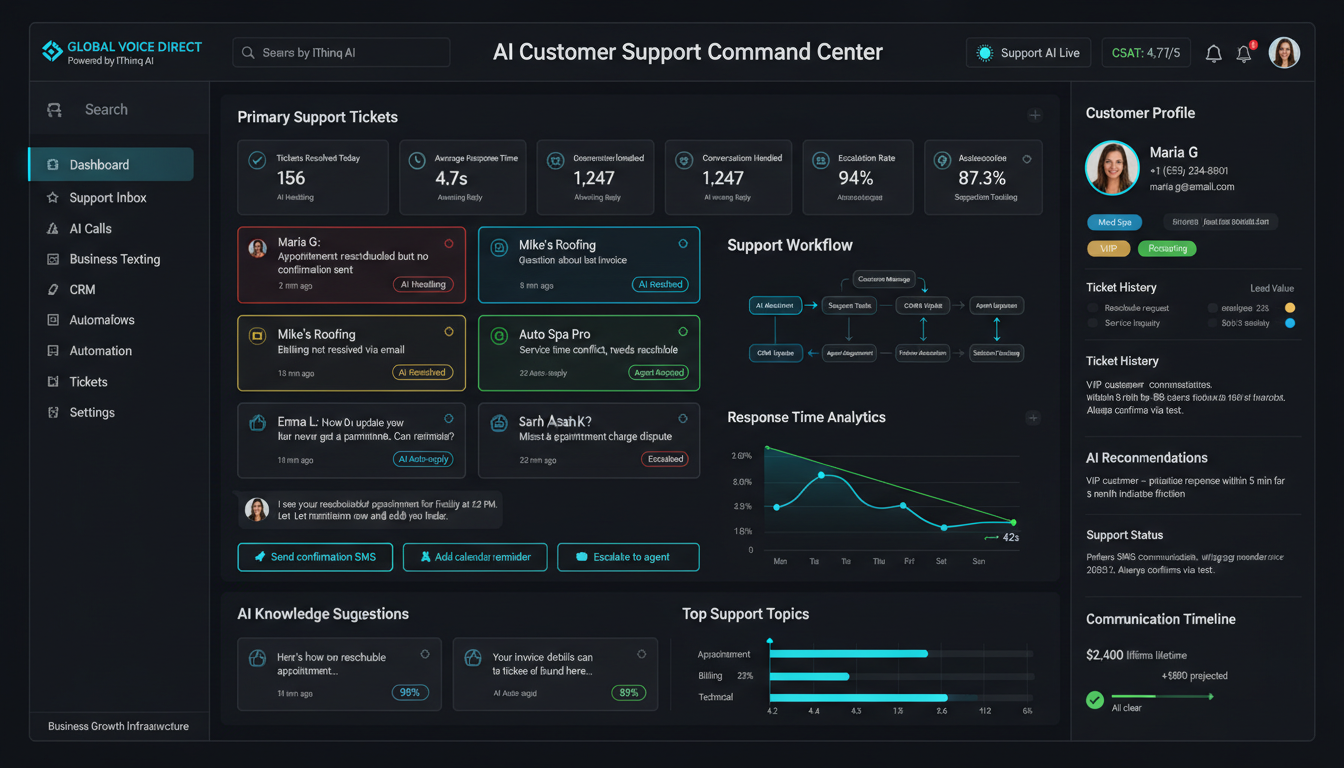
Platforms like IThinq AI help businesses use AI and automation to stay responsive, consistent, and connected — because technology that supports communication supports trust.
The Trust Flywheel™
Trust does not just build loyalty. It generates growth.
When a business earns genuine trust, it sets in motion a compounding cycle. That cycle accelerates over time — each revolution harder to stop than the last.
The Trust Flywheel™
The Trust Flywheel™ is not theoretical. It describes what happens naturally when a business prioritizes all six pillars of the Business Trust Framework™ simultaneously.
Every satisfied customer becomes a proof point. Every proof point reduces friction for the next customer. Every new customer who converts and trusts the business adds more momentum to the flywheel.
This is why the businesses most trusted today tend to dominate their categories tomorrow.
Common Trust Killers
Trust is fragile. It takes months to build and seconds to break.
Understanding what destroys trust is just as important as understanding how to build it.
Business Trust Audit™
Use this checklist to evaluate where your business currently stands across the six pillars of the Business Trust Framework™.
✅ Business Trust Audit™ Checklist
The more items checked, the stronger your trust infrastructure. Gaps reveal exactly where to focus next.
Trust Is Built In Small Moments
Most entrepreneurs think trust is built in the big moments — a perfect product launch, a viral post, a five-star review campaign.
But in my experience building multiple businesses, trust is actually built in the small moments that most people overlook.
It is built the moment you answer a call when no one would have noticed if you did not. It is built when you follow up two days after a conversation because you said you would. It is built when your service is exactly what you promised on a day when it would have been easy to cut corners.
Those moments stack. They compound. They become the reputation that people talk about when you are not in the room.
The businesses I most respect — and the ones that tend to grow the fastest without burning out — are not the loudest. They are the most reliable. They have built trust as intentionally as they have built their product.
That is what the Business Trust Framework™ is designed to help you do. Not just look trustworthy. Actually be trustworthy — in the systems, the processes, and the small moments that nobody celebrates but everybody notices.
— Jonas Janvier, Founder, Global Voice Direct & IThinq AI
Business Trust Score™
The Business Trust Score™ measures a business’s trust posture across five categories most likely to influence customer confidence and long-term growth.
pts available
pts available
pts available
pts available
pts available
| Trust Factor | Description | Business Impact | Score | Recommended Action |
|---|---|---|---|---|
| Credibility | Professional presence, verified information, business formation | First-impression trust, vendor & lender confidence | 20 pts | Audit all public-facing business information |
| Communication | Response time, accessibility, follow-up reliability | Lead conversion, retention, complaint resolution | 20 pts | Implement a professional phone system and CRM workflow |
| Consistency | Predictable service quality, reliable delivery | Repeat business, loyalty, referral generation | 20 pts | Document service processes and quality checkpoints |
| Customer Experience | Ease of doing business, touchpoint quality | Lifetime value, 5-star reviews, retention | 20 pts | Map every customer touchpoint and remove friction |
| Reputation | Reviews, referrals, word-of-mouth | Organic growth, market authority, brand equity | 20 pts | Launch a proactive review and referral program |
Score Interpretation: 90–100 = Trust Leader · 70–89 = Trust Builder · 50–69 = Trust Gap · Below 50 = Trust Crisis. The weakest pillar sets the ceiling for the overall score — fix it first.
How To Increase Business Trust
Building business trust does not require a massive budget. It requires intention, consistency, and the right systems.
Step 1 — Audit Your Current Trust Signals
Use the Business Trust Audit™ above to identify which pillars are strongest and which have gaps. Start with the gaps.
Step 2 — Fix Your Credibility Infrastructure First
A professional website, business email, and verified phone number are the minimum viable credibility stack. The Business Credibility Framework walks through each element in detail.
Step 3 — Build a Communication System
Every missed call costs more than most businesses track. Implement a system — phone, CRM, automation — that ensures no inquiry goes unanswered. The Communication Systems Framework provides a clear roadmap.
Step 4 — Create Repeatable Service Processes
Consistency is not accidental. Document your core service processes so quality does not depend on who is available that day.
Step 5 — Collect and Leverage Social Proof
Trust claims without evidence are easily ignored. Build a proactive review collection process. The Referral Growth Framework shows how to turn satisfied customers into a consistent source of new business.
Step 6 — Protect and Monitor Your Reputation
Monitor your reviews, respond to every piece of feedback, and treat every complaint as a trust-recovery opportunity.
The Entrepreneur Infrastructure Model ties all of these steps together into a unified business-building system designed for long-term, sustainable growth.
Frequently Asked Questions — Business Trust Framework
What is a Business Trust Framework?
A Business Trust Framework is a structured system for understanding, building, and measuring the trust a business earns from its customers, partners, and the broader market. The Business Trust Framework™ by Jonas Janvier organizes trust-building into six pillars: Credibility, Communication, Consistency, Customer Experience, Proof, and Reputation.
What is business trust?
Business trust is the level of confidence that customers, partners, and the market have that a business will do what it says it will do. It is built through consistent actions, honest communication, and reliable delivery over time.
Why is trust important for business growth?
Trust directly influences purchasing decisions, referrals, customer retention, and brand reputation. Businesses that earn genuine trust tend to grow faster, retain customers longer, and generate more organic referrals than businesses that compete primarily on price or awareness.
How do businesses build trust with customers?
Businesses build trust by establishing credibility through professional infrastructure, communicating reliably and responsively, delivering consistent service quality, creating positive customer experiences at every touchpoint, demonstrating proof through reviews and testimonials, and protecting their reputation over time.
What destroys business trust?
Business trust is destroyed by poor communication, missed commitments, inconsistent service quality, lack of transparency, slow responses to complaints, and a failure to follow through on promises. Even small failures compound over time into significant trust deficits.
Why does communication matter for business trust?
Communication is one of the most visible signals a business sends to its customers. Responsive, clear, and reliable communication demonstrates respect for the customer’s time and builds confidence that the business will follow through. Slow or poor communication is one of the fastest ways to lose trust.
How does trust impact business growth?
Trust impacts growth through the Trust Flywheel™ — trust improves customer experience, which generates positive reviews, which increases referrals, which drives more growth, which compounds into even greater trust. Businesses with strong trust foundations grow organically and sustainably.
What are the pillars of the Business Trust Framework?
The six pillars of the Business Trust Framework™ are: Credibility, Communication, Consistency, Customer Experience, Proof, and Reputation. Each pillar reinforces the others, and weakness in any one pillar limits the effectiveness of the rest.
What is business credibility?
Business credibility is the perception that a company is legitimate, qualified, and capable of delivering on its commitments. It is established through verifiable signals including proper business formation, a professional website, a dedicated business email, a verified phone number, and consistent branding.
What is customer confidence in business?
Customer confidence in business is a buyer’s belief that a company will deliver on its promises before, during, and after a transaction. High customer confidence reduces hesitation, increases purchase likelihood, and creates the conditions for loyalty and referrals.
How does consistency build business reputation?
Consistency builds reputation by accumulating a track record of reliable, predictable delivery across hundreds of customer interactions. When customers know what to expect and that expectation is consistently met, trust deepens into loyalty. Reputation is what happens when consistency is observed over time by enough people.
What are trust signals in business?
Trust signals are observable indicators that communicate legitimacy, reliability, and capability to potential customers. Examples include a professional website, verified business contact information, online reviews, industry certifications, case studies, consistent branding, and responsive communication.
How does customer experience affect trust?
Every interaction a customer has with a business is either a trust-building or trust-eroding moment. Positive experiences across the full customer journey compound into a strong trust foundation. Negative experiences, even isolated ones, can undermine trust built over months.
What is the Trust Flywheel?
The Trust Flywheel™ is a compounding growth cycle in which trust leads to better customer experiences, which generate more positive reviews, which drive more referrals, which create more growth, which reinforces and deepens trust. Once in motion, each revolution becomes more powerful than the last.
How do you measure business trust?
Business trust can be measured using the Business Trust Score™, which evaluates a company across five categories — Credibility, Communication, Consistency, Customer Experience, and Reputation — each weighted equally at 20 points for a maximum score of 100.
What is a Business Trust Score?
A Business Trust Score is a structured assessment of a company’s overall trust posture across five pillars. Scores of 90–100 indicate a Trust Leader. Scores below 50 indicate a Trust Crisis. The lowest-scoring pillar represents the highest-priority area for improvement.
How do you conduct a Business Trust Audit?
A Business Trust Audit evaluates a company’s trust infrastructure across all six pillars of the Business Trust Framework™. The audit checklist covers professional digital presence, communication systems, consistency processes, customer experience touchpoints, social proof collection, and reputation management practices.
Can small businesses build strong trust quickly?
Yes. Small businesses often have an advantage in trust-building because they can deliver a more personal, consistent experience than larger competitors. The key is to prioritize credibility infrastructure first, then focus on communication reliability and consistency. Trust compounds quickly when the fundamentals are in place.
How does technology support business trust?
Technology supports business trust by enabling the consistency and responsiveness that trust requires. CRM systems ensure every customer relationship is tracked and followed up on. AI-powered communication tools ensure no inquiry goes unanswered. Automation closes the gaps that human error would otherwise create.
What is the difference between business credibility and business trust?
Business credibility is the foundation — it makes a business look legitimate and worth considering. Business trust is what is built after credibility is established, through consistent delivery, reliable communication, and positive customer experiences over time. Credibility earns the first opportunity. Trust earns all the ones that follow.
Trust Is One Of The Most Valuable Assets A Business Can Build
The businesses that earn trust consistently create stronger customer relationships, better referrals, and more sustainable growth. The Business Trust Framework™ gives you a clear system to build it intentionally.
Explore the Entrepreneur Infrastructure Model