

The Funding Readiness Framework: Why Some Businesses Get Approved While Others Get Ignored
Funding is rarely the result of luck. It is usually the result of preparation — and most businesses start preparing too late.

The Funding Readiness Framework™ is a structured system that helps businesses build the credibility, infrastructure, and operational consistency that lenders, vendors, and partners look for before extending opportunities. It covers six pillars: Business Identity, Credibility, Communication Infrastructure, Operational Consistency, Financial Organization, and Growth Readiness. Businesses that build these pillars before applying for funding are significantly more likely to receive approvals, better terms, and repeat opportunities.
📋 Table of Contents
- What Is Funding Readiness?
- The Funding Readiness Framework™
- Why Credibility Matters First
- Communication Infrastructure
- Technology and Operations
- The Funding Confidence Flywheel™
- Common Mistakes
- Funding Readiness Audit™
- Founder Insight
- Funding Readiness Score™
- How to Improve
- Frequently Asked Questions
Many business owners believe funding begins when they submit an application.
In reality, funding preparation begins long before that moment ever arrives.
Lenders evaluate signals. Vendors evaluate credibility. Investors evaluate infrastructure. Partners evaluate consistency. And by the time you are sitting in front of an opportunity, those signals have already been building — or they have not.
The businesses that get approved are rarely smarter or luckier than the ones that get ignored. They are simply more prepared.
This guide introduces the Funding Readiness Framework™ — a practical system for building the infrastructure, credibility, and operational consistency that positions a business to attract and receive funding opportunities.
What Is Funding Readiness?
Funding readiness is the degree to which a business has built the identity, credibility, systems, and documentation needed to be evaluated favorably by lenders, vendors, investors, and strategic partners.
It is not just about having a good credit score or a solid business plan. It is about every layer of how your business presents itself — from the phone number you list on your application to the consistency of your business address across public databases.
The condition of a business having the infrastructure, credibility signals, communication systems, and operational documentation required to be evaluated positively by funding sources, lenders, and strategic partners.
The foundational systems, tools, processes, and structures that allow a business to operate consistently, scale predictably, and present itself professionally to outside evaluators.
The sum of the signals — formation documents, verified contact information, consistent business identity, professional communication, and operational history — that tell outside parties the business is legitimate and trustworthy.
The process of confirming that a business exists, is properly registered, and matches its public-facing information across business databases, credit bureaus, and commercial registries.
Most businesses do not fail to get funded because they have a bad idea. They fail because they have not built the signals that make an evaluator confident enough to say yes.
The Funding Readiness Framework™
The Funding Readiness Framework™ is built on six pillars. Each pillar addresses a different dimension of what evaluators look for before approving a business for funding, vendor credit, or strategic partnerships.
| Pillar | Name | What It Covers | Why It Matters |
|---|---|---|---|
| 01 | Business Identity | Formation, EIN, registered address, business name consistency | Establishes the business exists as a legal, verifiable entity |
| 02 | Business Credibility | Licenses, verifications, reviews, trust signals, brand consistency | Signals legitimacy to lenders and evaluators before they engage |
| 03 | Communication Infrastructure | Dedicated business phone, professional email, responsiveness systems | Creates the perception and reality of an organized, accessible operation |
| 04 | Operational Consistency | SOPs, workflows, documented processes, team systems | Demonstrates the business can operate without depending on one person |
| 05 | Financial Organization | Separated business banking, bookkeeping, revenue history, tax compliance | Provides the financial paper trail evaluators require for approval decisions |
| 06 | Growth Readiness | Market positioning, growth systems, scalable infrastructure, documented strategy | Shows the business has a plan to deploy capital effectively and return value |
- Funding readiness is built across six distinct pillars, not just one area
- Each pillar sends specific signals to lenders, vendors, and partners
- Weakness in any single pillar can reduce the overall readiness score
- Businesses that strengthen all six pillars create a compounding credibility advantage
- The strongest applications are built months before the application is submitted
Why Credibility Matters Before Funding

Credibility is not something you build the week before you apply for funding. It is something that accumulates over time through consistent signals that tell the market, and potential funding sources, that your business is real, organized, and trustworthy.
Lenders and evaluators are not just evaluating your financials. They are evaluating your legitimacy. They want to know that you have a real business address. That your business name is consistent across filings. That you have a professional phone number. That your business shows up in the places a legitimate business should show up.
These signals are part of what the Business Credibility Framework™ addresses — a structured approach to building and maintaining the trust signals that position a business for opportunity.
Trust
Trust is built through consistent behavior over time. Every interaction, record, and signal either adds to or detracts from the confidence evaluators place in your business.
Legitimacy
Legitimacy comes from proper formation, verified documentation, and consistent business identity across all public-facing registries and records.
Verification
Business verification — through Dun & Bradstreet, SBA, state registries, and industry databases — confirms that your business meets the baseline requirements evaluators check first.
Reputation
Online reviews, testimonials, social proof, and consistent brand messaging all contribute to the reputation signals that evaluators factor into their decisions.
A business that has built strong credibility signals is easier to approve. The evaluator does not have to work hard to confirm the basics. When those signals are weak or inconsistent, the evaluator hesitates — and hesitation often becomes a no.
The Startup Verification Framework™ provides a structured approach to the verification layer specifically, helping new businesses establish the documentation trail that makes credibility easy to confirm.
Communication Infrastructure Influences Perception

The phone number on your funding application matters more than most business owners realize.
When a lender or vendor calls that number and gets a generic voicemail, or no answer at all, it raises questions. When they call and reach a professional, organized communication system, it confirms what your application claims: that this is a real business with real infrastructure.
Communication infrastructure covers three dimensions that directly affect funding readiness:
Responsiveness
How quickly and consistently does your business respond to calls, messages, and inquiries? Slow or inconsistent response signals operational weakness.
Professionalism
Do your communication touchpoints reflect a well-organized business? A dedicated business number, professional greeting, and structured call handling all contribute to evaluator confidence.
Accessibility
Can evaluators and partners reach you through consistent, verified channels? Accessibility signals that the business is open, operational, and easy to engage.
Businesses like those using Global Voice Direct implement professional communication infrastructure specifically to create the responsiveness, accessibility, and professionalism signals that evaluators want to see. A dedicated business phone line with professional handling is not just a communication tool — it is a credibility signal.
The Communication Systems Framework™ provides a deeper look at how to build this infrastructure layer from the ground up.
Technology Creates Operational Readiness
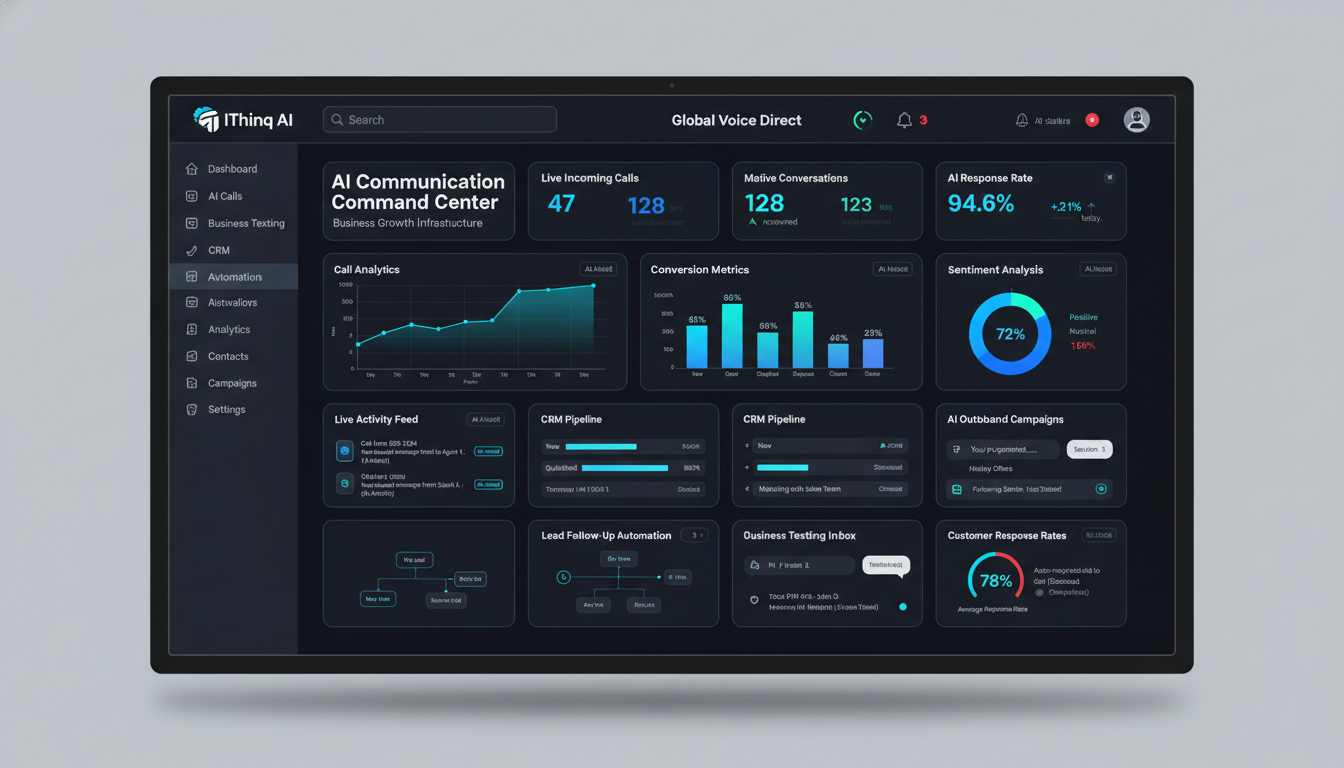
Evaluators are not just looking at what your business has done. They are looking at how your business operates — and whether it can sustain performance as it grows.
Technology infrastructure provides visible evidence of operational maturity. When a business has CRM systems managing customer relationships, automation handling routine processes, and reporting tools providing visibility into performance, it signals that the business is organized enough to handle capital responsibly.
CRM Systems
Customer relationship management tools show that the business tracks, manages, and nurtures its client base systematically rather than relying on memory or informal methods.
Automation
Automated workflows reduce human error, increase consistency, and free up leadership capacity — all of which signal operational discipline to evaluators.
Reporting
Businesses with reporting infrastructure can quickly produce the documentation evaluators request — revenue histories, customer metrics, and operational data.
Customer Management
Structured customer management systems demonstrate that the business can retain and serve clients at scale — reducing perceived risk for any funding source.
Companies like IThinq AI provide the kind of AI-powered automation and operational tools that help businesses build this operational readiness layer — the technology infrastructure that signals organizational maturity to lenders and investors.
The Startup Technology Stack Framework™ covers how to select, implement, and leverage the right tools for each stage of business growth.
The Funding Confidence Flywheel™
Funding readiness is not a one-time task. It is a compounding system. Each layer you build strengthens the next, and the cumulative effect is a business that naturally attracts more opportunities over time.
This is what the Funding Confidence Flywheel™ describes:
When you build credibility, you earn trust. When trust is verified, you become ready for opportunities. When you receive opportunities and grow, your credibility increases further. The cycle repeats — but only if the infrastructure is in place to sustain it.
Businesses that skip the early infrastructure steps often break the flywheel before it has a chance to build momentum. The Entrepreneur Infrastructure Model™ outlines how to sequence these investments correctly from the start.
Common Funding Readiness Mistakes
Most businesses are not rejected because they are unworthy of funding. They are rejected because they made avoidable preparation mistakes that undermined evaluator confidence.
- Poor Documentation. Missing formation documents, inconsistent business records, or gaps in financial history create doubt that no pitch can overcome.
- Weak Business Identity. A business name that does not match across filings, a personal phone number on the application, and an unverified address all signal disorganization.
- Inconsistent Communication. Unreturned calls, generic voicemail greetings, and slow email response times all reduce evaluator confidence before the formal review even begins.
- Lack of Systems. Businesses that cannot demonstrate operational processes, customer management, or team workflows appear too dependent on the founder to scale responsibly.
- No Operational Processes. When a business has no documented SOPs, workflows, or decision frameworks, it signals that operations are informal — and informal operations carry elevated risk for any funding source.
- Applying Too Early. Applying for funding before the infrastructure is in place is one of the most common — and costly — funding mistakes. An early rejection can create a negative record that affects future applications.
Funding Readiness Audit™
Use this checklist to evaluate your current funding readiness across all six pillars. Each item represents a signal that evaluators commonly review during the decision process.
- Business is formally registered with the appropriate state or federal agencies
- EIN (Employer Identification Number) is active and on file
- Business name is consistent across all public records, filings, and registries
- Registered business address is verified and consistent
- Dedicated business phone number is active and professionally answered
- Professional business email is in use (no personal Gmail addresses)
- Business website is live, professional, and consistent with other brand materials
- Business bank account is separate from personal accounts
- Business bookkeeping is current and organized
- Revenue history is documented and accessible
- Tax filings are current and compliant
- Business profile is verified on Dun & Bradstreet, Experian Business, or Equifax Business
- Customer management system (CRM) is in place
- Operational SOPs are documented for core business functions
- Online reviews and reputation signals are positive and consistent
- Business licenses and permits are current and on file
- Business credit history has been established through trade lines or vendor accounts
- Growth strategy is documented and aligned with capital deployment goals
- Team or contractor capacity is sufficient to support funded growth
- Marketing and customer acquisition systems are in place and documented
Funding Usually Follows Preparation
When I started building businesses, I made the same mistake a lot of founders make. I thought about funding when I needed it. I thought about credibility when someone asked for it. I thought about systems when things started breaking.
What I learned — usually the hard way — is that the businesses that attract the best opportunities are not scrambling to get ready when an opportunity appears. They were already ready. The infrastructure was already built. The credibility signals were already in place. The documentation was already organized.
That is why I built the Business Infrastructure Framework™ — because I wanted a clear, structured way to help founders build these things in the right order, before they need them. Not after.
Funding is not something that happens to prepared businesses by accident. It is something that prepared businesses earn — consistently, repeatably, and at a much higher rate than businesses that are still trying to get organized when the application is already in front of them.
Build the infrastructure first. The opportunities tend to follow.
— Jonas Janvier
Funding Readiness Score™
The Funding Readiness Score™ gives you a way to evaluate your business across five categories and identify which areas need the most immediate attention before you pursue any funding opportunity.
Credibility
Business identity consistency, trust signals, verification status, online reputation, and brand professionalism across all public-facing channels.
Verification
Business registration documentation, EIN status, D&B profile, address verification, and consistency across commercial databases and credit bureaus.
Communication
Dedicated business phone line, professional email, response time infrastructure, and accessible communication channels.
Operations
Documented SOPs, CRM systems, automation infrastructure, team capacity, and ability to demonstrate operational consistency to evaluators.
Growth Readiness
Documented growth strategy, revenue history, market positioning, financial organization, and capital deployment plan.
- 85–100: High funding readiness — well-positioned to pursue most opportunities
- 65–84: Moderate readiness — address identified gaps before major applications
- 45–64: Developing readiness — focus on foundational infrastructure before pursuing funding
- Below 45: Early stage — prioritize formation, verification, and communication infrastructure first
How to Improve Funding Readiness
Improving funding readiness is a sequential process. Start with the foundation and build outward. Trying to fix the advanced layers without addressing the basics is one of the most common mistakes businesses make.
Establish Your Business Identity
Register your business properly, obtain your EIN, establish a registered address, and ensure your business name is consistent across all filings and public records.
Build Credibility Signals
Get listed in business directories, verify your D&B profile, collect reviews, and ensure your brand is consistent and professional across all channels.
Set Up Communication Infrastructure
Establish a dedicated business phone number, professional email, and a system for responding to inquiries consistently and professionally.
Separate and Organize Finances
Open a dedicated business bank account, establish bookkeeping systems, and ensure your financial records are organized enough to share on short notice.
Document Your Operations
Create SOPs for your core business processes, implement a CRM or customer management system, and document your team’s roles and responsibilities.
Build a Growth Strategy
Document your market positioning, customer acquisition systems, and capital deployment plan so that any evaluator can see clearly how funding will be used and what returns it supports.
This six-step process mirrors the six pillars of the Funding Readiness Framework™. Completing them in order ensures that each layer of readiness is built on a solid foundation. The Startup Growth Systems Framework™ provides detailed guidance on building the growth layer specifically.
Frequently Asked Questions About the Funding Readiness Framework
Opportunities Favor Prepared Businesses
Funding readiness is the result of strong infrastructure, credibility, communication systems, and consistent execution — built long before the opportunity arrives.
Explore the Framework Infrastructure Model