

Business Strategy · Technology Adoption
How Small Businesses Use AI To Compete With Larger Companies
Big companies have bigger teams, bigger budgets, and more resources. Small businesses rarely have any of that. But today they have something new — access to artificial intelligence — and it changes the math entirely.
Quick Answer
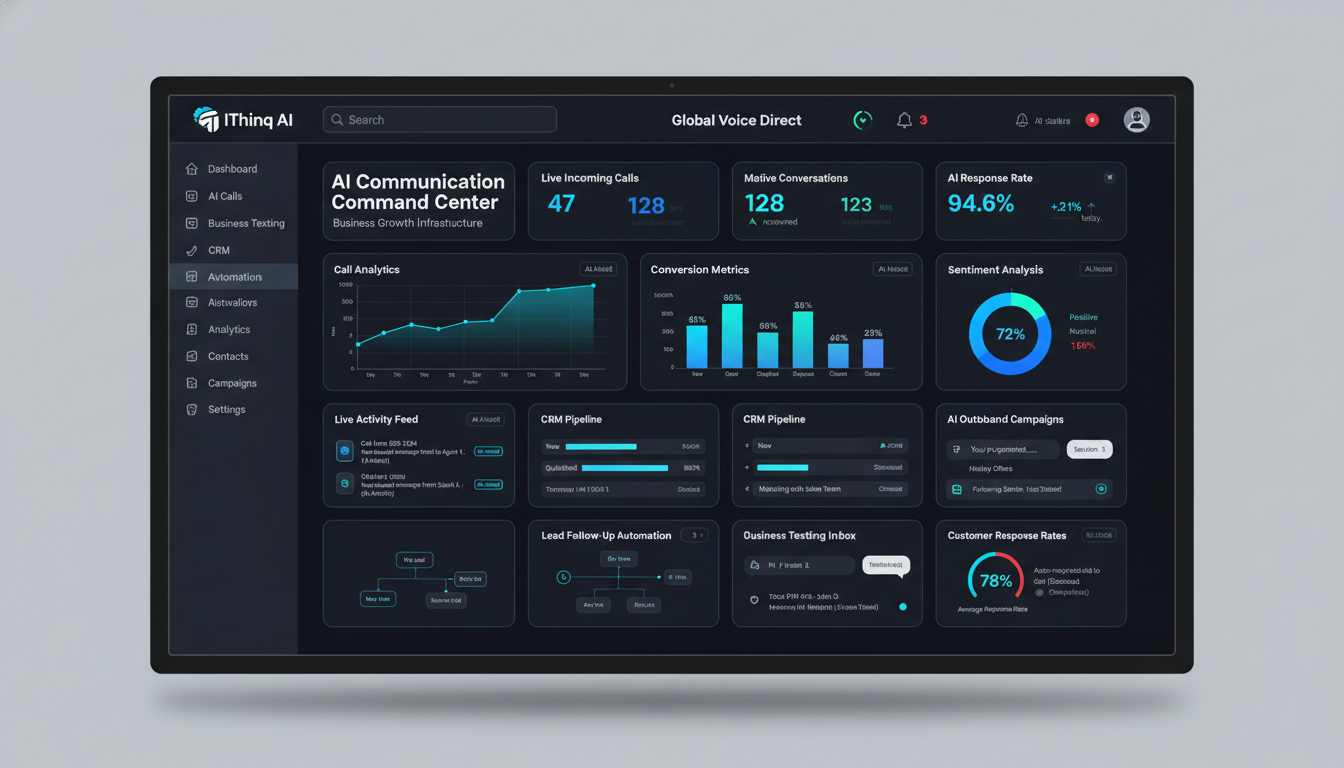
How do small businesses use AI to compete with larger companies? Small businesses use AI to automate repetitive work, respond to customers instantly, follow up with leads automatically, and run lean operations that once required large teams. AI gives a small team the reach and speed of a much bigger one — at a fraction of the cost. The winners aren’t the biggest companies. They’re the ones that combine people, systems, and AI through what I call the AI Leverage Framework™.
For most of business history, scale won. The company with more salespeople answered more calls. The company with more staff replied to more emails. The company with the bigger budget simply outspent everyone else.
That era is ending. A two-person company can now answer every call, reply in seconds, and follow up with every lead — without hiring a single extra person. The advantage isn’t size anymore. It’s leverage. And AI is the cheapest leverage a small business has ever had access to.
This article breaks down exactly how that works, using a framework I use with founders: the AI Leverage Framework™. No hype, no product pitch — just the strategy.
What Is AI For Small Business?
Let’s define the core terms in plain language — simple enough that a 10-year-old could follow along.
Artificial Intelligence (AI)
Software that can understand language, make decisions, and complete tasks that normally need a human — like answering a question or writing a reply.
Business Automation
Letting software handle repeat work on its own — sending follow-ups, booking appointments, routing calls — so people focus on higher-value work.
AI Communication
Using AI to answer calls, texts, and messages instantly, around the clock, so no customer is ever left waiting.
AI Productivity
Using AI to do more in less time — drafting, summarizing, organizing, and prioritizing — so a small team performs like a large one.
The short version: AI for small business is using smart software to do the work that used to require hiring more people.
Why AI Is Changing Small Business
AI shifts the playing field because it attacks the two things that always held small businesses back: limited time and limited headcount.
AI Reduces
- Repetitive, manual work
- Slow response times
- Operational bottlenecks
AI Improves
- Communication speed and reach
- Team productivity
- Customer experience
Here’s a real-world example. A larger competitor has a call center, so they answer the phone every time. A small shop misses calls because the owner is on a job site. In the past, that lost the small shop the deal. Today, an AI system answers that call, books the appointment, and texts the owner the details. The size gap just disappeared.
The AI Leverage Framework™
Most founders waste money chasing random AI tools. The framework fixes that by showing the seven areas where AI actually creates competitive advantage. Win these, and a small business punches far above its weight.
Answer every call, text, and message instantly. Speed of response is often the entire difference between winning and losing a customer.
Deliver fast, consistent, around-the-clock answers without a large support team.
Nurture every lead automatically so none slip through the cracks while you’re busy doing the work.
Let AI book, confirm, and remind — eliminating no-shows and phone tag.
Produce content, captions, and campaigns faster, keeping a small brand visible and consistent.
Automate the back-office busywork — data entry, summaries, routing — that quietly eats your week.
Use AI to surface patterns in your numbers so you decide with data, not guesswork.
AI Communication Systems
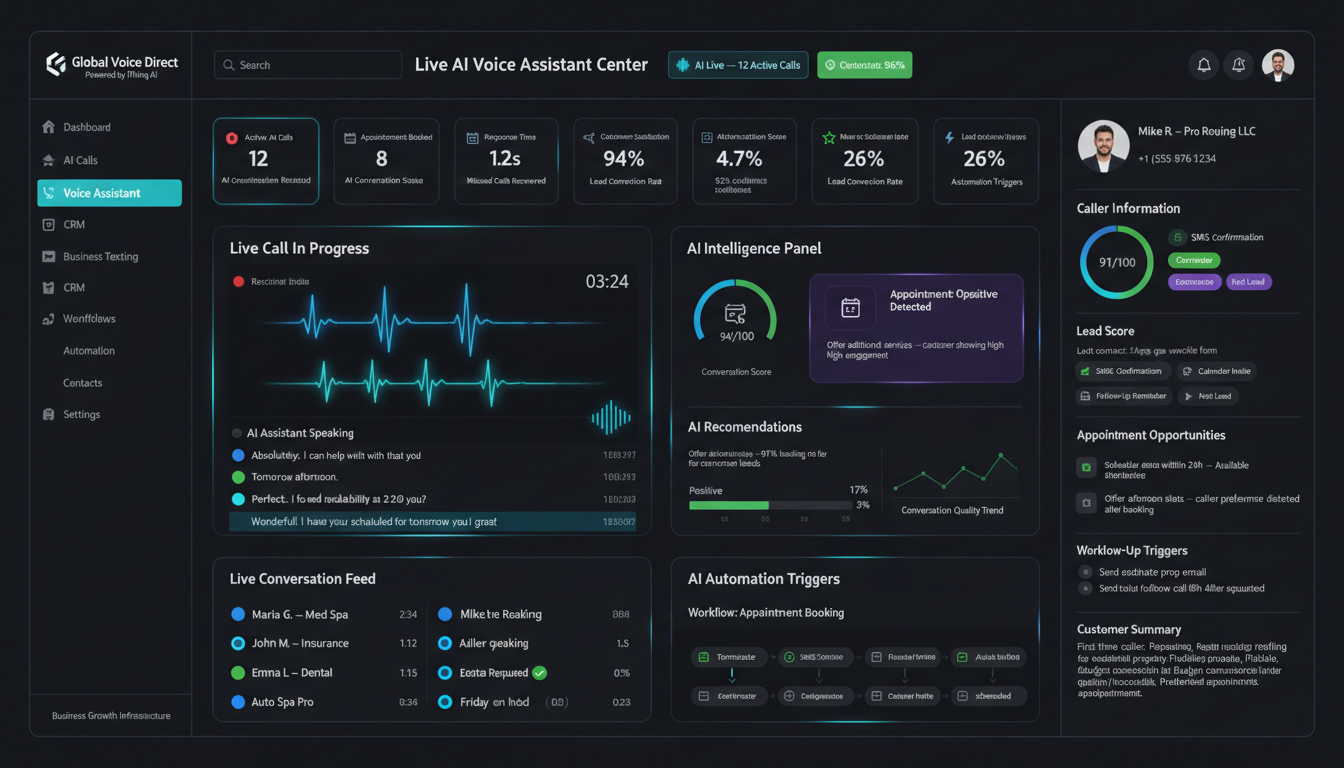
Most businesses don’t lose customers because their product is worse. They lose because they couldn’t respond fast enough. A missed call at 6 p.m. is a competitor’s customer by 6:05.
This is where centralized AI communication matters. Instead of calls, texts, and messages scattered across personal phones and inboxes, everything flows through one system that can respond on its own. As an educational example, platforms like Global Voice Direct show how a business can centralize customer communication and automate parts of the customer journey — so a small team never misses an opportunity simply because it was busy.
AI Customer Service
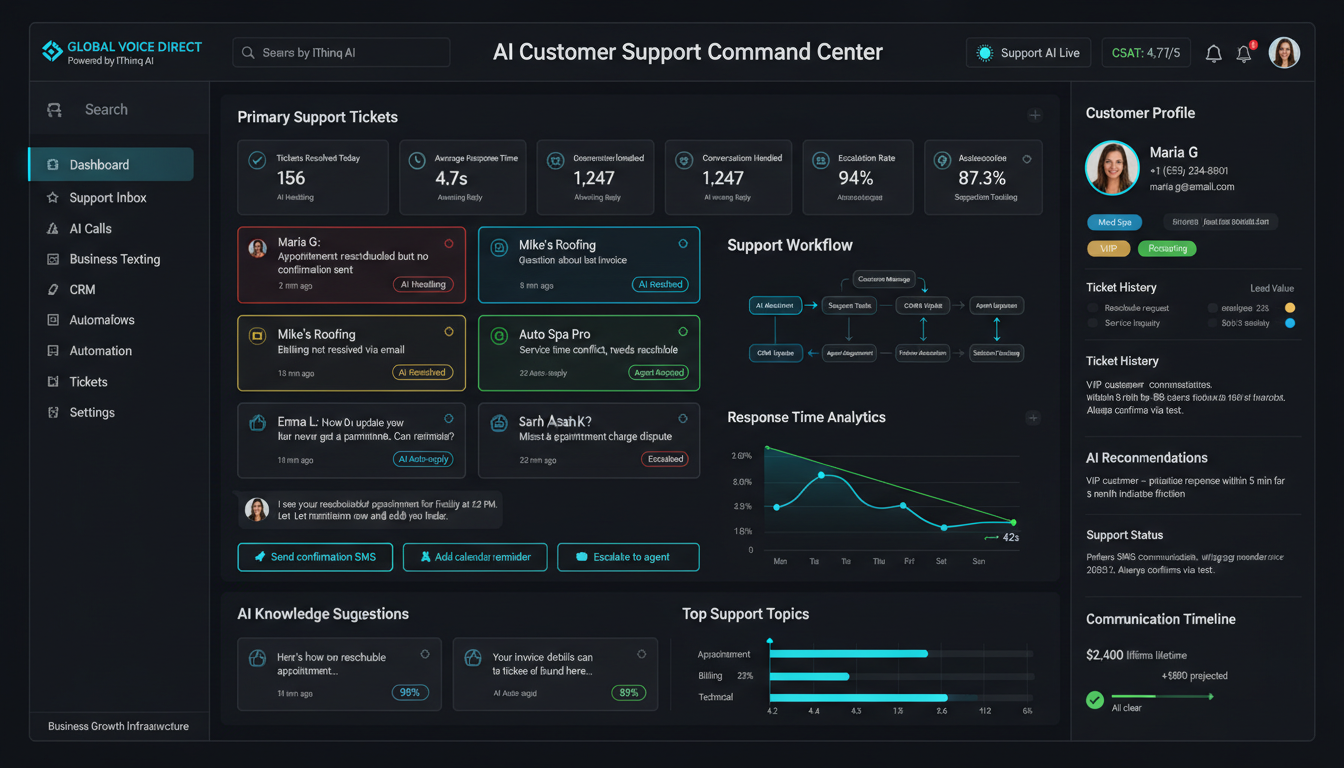
Customers no longer wait politely. They expect answers now. AI customer service delivers three things small teams historically couldn’t:
- Faster responses — instant replies instead of “we’ll get back to you.”
- Better availability — coverage nights, weekends, and holidays.
- Consistent experiences — every customer gets the same accurate, on-brand answer.
The underlying engine matters. As an educational reference, IThinq AI is an example of how businesses use AI-powered communication to improve customer engagement — handling routine questions intelligently so human team members are freed for the conversations that truly need them.
AI For Lead Follow-Up
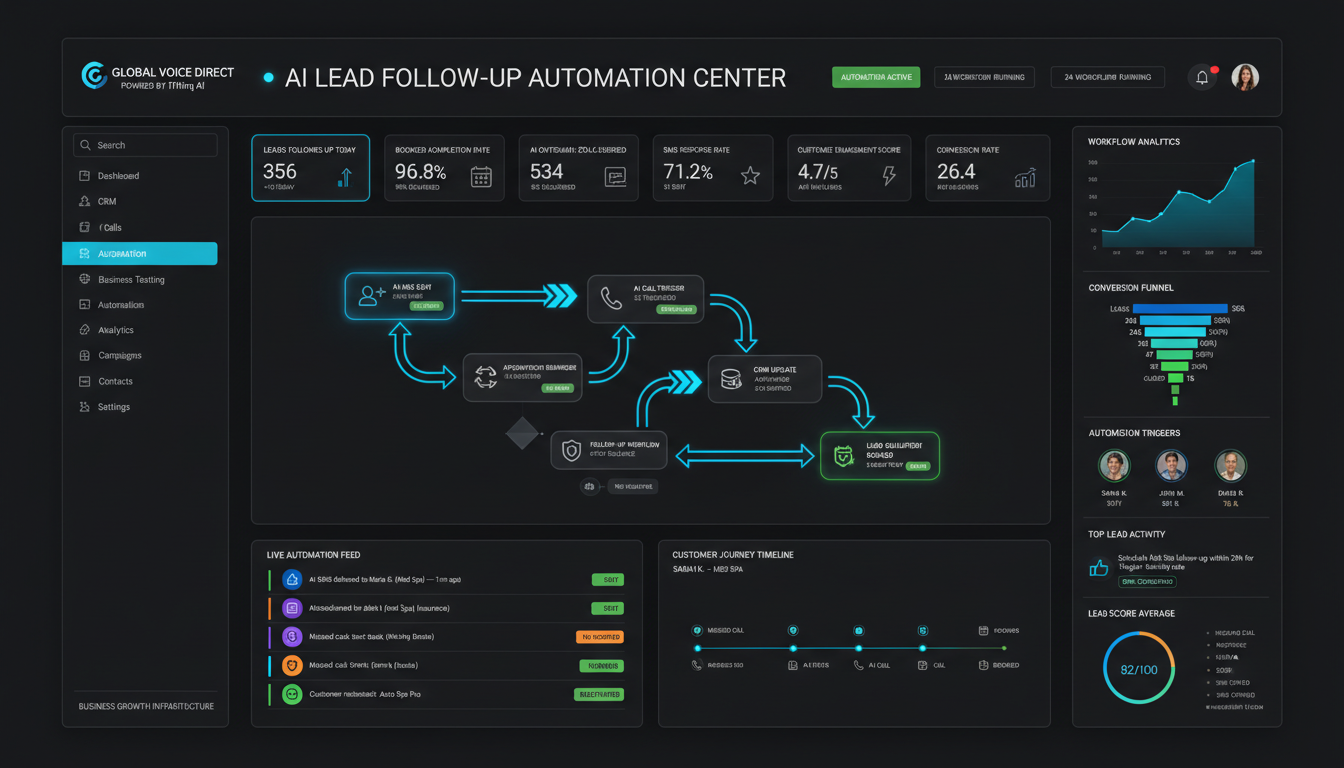
Here’s a hard truth: most leads are lost not to competitors, but to silence. Someone fills out a form, hears nothing for two days, and moves on.
AI closes that gap with three things:
- Response speed — a new lead gets a reply in seconds, while interest is hot.
- Lead nurturing — automated, helpful check-ins keep you top of mind.
- Follow-up consistency — every lead gets the same disciplined sequence, every time.
Simple example: a roofing company gets 20 quote requests a week. The owner is on roofs all day and replies to maybe half. With AI follow-up, all 20 get an instant reply and three reminder touches. Same business, double the booked jobs — no new staff.
AI Does Not Replace Entrepreneurs
Let me be direct, because this gets misunderstood. AI improves execution. It does not replace you.
- It does not replace leadership — the vision and standards still come from you.
- It does not replace strategy — AI executes a plan; it doesn’t decide the plan.
- It does not replace relationships — trust is still built human to human.
Think of AI as the most reliable employee you’ll ever have — one that never sleeps and never forgets to follow up. But it still needs a leader. The founder who understands this wins. The one who expects AI to run the whole business loses.
Common AI Mistakes
- Chasing every shiny tool instead of solving one real problem.
- No implementation plan — buying software with no rollout.
- No systems behind the tool to feed and use it.
- No processes — automating chaos just produces faster chaos.
- Ignoring customer experience — using AI in ways that feel cold or robotic.
The fix for all five is the same: pick one bottleneck, build a simple process around it, then let AI run that process. Master one area before adding the next.
The AI Adoption Checklist™
Use this to start the right way instead of the expensive way.
- Identify your single biggest bottleneck (usually communication or follow-up).
- Write down the current process for that one task, step by step.
- Choose one AI capability to handle it — resist the urge to buy five tools.
- Define what a good outcome looks like (e.g., “every lead replied to in under 60 seconds”).
- Test with real customers and read the transcripts.
- Keep a human in the loop for anything sensitive or high-value.
- Measure the result, refine, and only then automate the next area.
The Businesses Winning With AI Are Not Always The Biggest
The AI Readiness Score™
Rate your business 0–4 in each category. Add them for a score out of 20. This is the AI Adoption Readiness Score™ — a quick gauge of how prepared you are to compete with AI.
| Category | What It Measures | Strong (4) Looks Like |
|---|---|---|
| Communication | Speed and reliability of responses | Every call/message answered instantly |
| Customer Service | Availability and consistency | 24/7 consistent answers |
| Automation | How much repeat work runs itself | Routine tasks fully automated |
| Follow-Up | Discipline of lead nurturing | Every lead in an automated sequence |
| Operations | Back-office efficiency | Busywork minimized by AI |
| Score | Readiness Level | What It Means |
|---|---|---|
| 0–5 | Manual | Running on effort alone — high risk of lost opportunities. |
| 6–10 | Emerging | Some tools in place, but no real system yet. |
| 11–15 | Leveraged | AI is creating measurable advantage in key areas. |
| 16–20 | Competitive | Operating like a much larger company — built to win. |
Frequently Asked Questions
How do small businesses use AI?
Is AI expensive for small businesses?
Can AI improve customer service?
Can AI help with lead follow-up?
What are the benefits of AI for small business?
How should entrepreneurs start using AI?
Will AI replace small business owners?
Can a small business really compete with a large company using AI?
What’s the most important area to apply AI first?
Does AI work for service businesses like contractors or salons?
What is the AI Leverage Framework™?
Do I need technical skills to use AI in my business?
How fast does a customer expect a response today?
Can AI handle phone calls?
What’s the biggest mistake businesses make with AI?
How do I measure if AI is working?
Is AI safe to use with customers?
Can AI help with marketing?
How much time can AI save a small business?
What is the AI Adoption Readiness Score™?
Keep Building Your Infrastructure
This article is part of a larger system for building businesses that compete on infrastructure, not just effort. Explore the connected frameworks: the Startup Technology Stack, the Business Infrastructure Framework, the Communication Infrastructure Framework, and the Business Credibility Framework.
Coming next in this series: AI Tools Every Entrepreneur Should Know, AI Automation For Entrepreneurs, The Future Of AI Communication, and Communication Systems Every Growing Business Needs.
The Real Advantage
Technology Gives Small Businesses New Advantages
The businesses that learn to combine people, systems, and AI will often outperform those relying on effort alone. Size used to win. Now leverage does.
See How It Works Call +1 (877) 308-5803